
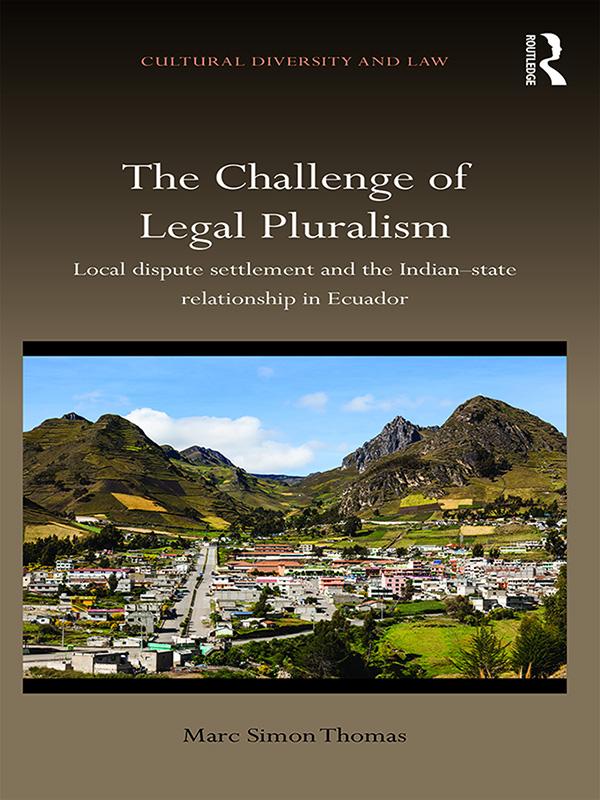
Within the Latin American context, legal pluralism is often depicted as a dichotomy between customary law and national law. In addition, the use of customary law alongside national law is frequently portrayed as a vehicle of resistance.
This book argues that, because ordinary Indians are not positively biased in favor of customary law per se, a heterogeneity of legal practices can be observed on a daily basis, which consequently undermines the commonly held view of customary law as a "counter-hegemonic strategy", even if, on other socio-geographical levels, this thinking in terms of resistance holds true. Based on qualitative research, the work analyzes how internal conflicts among indigenous inhabitants of the Ecuadorian highlands are being settled in a situation of formal legal pluralism, and what can be learned from this in terms of Indian-state relationships. It is shown that, on a local level, the phenomenological dimension of legal pluralism can be termed "interlegality." On a macro level, ontological assumptions underscore that legal pluralism is still seen as a dichotomy between customary and national law.
Multidisciplinary in nature, the book will be of interest to academics and researchers working in the areas of Legal Pluralism, Cultural Anthropology and Latin American Studies.
Betal enkelt med kort, Klarna, Apple Pay eller Google Pay. Ikke fornøyd? Du har alltid 14 dagers angrerett. Les mer i våre vilkår. Har du spørsmål, send oss en e-post på hello@memmo.org.
Memmo gjør det enklere å studere – uansett hvor du er i verden. Hos oss samler du pensumbøker og smarte studieverktøy på ett og samme sted: sammendrag, quizer, podkaster og flashcards. Og så Ted, din studiekompis som svarer på alt du lurer på. Over 50 000 studenter studerer allerede her – bygget for at du skal lære raskere og stresse mindre.