
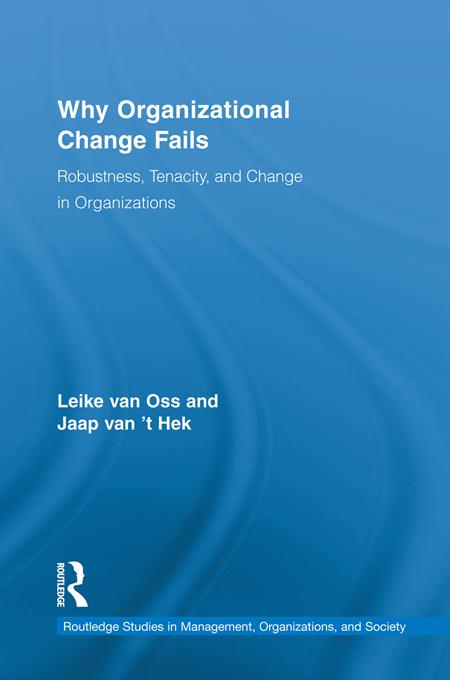
Change in organizations can arise spontaneously, or it can begin in response to a planned process of change. Even planned change is not as predictable as one might like it to be; it is often partial or incomplete, or the results of change may not be what one hoped. The aspects of an organization that resist change can be vital to an organization’s success, helping to keep it firm, stable, and robust.
Why Organizational Change Fails aims to make change managers and OD consultants sensitive to signals of the robust part of an organization, helping them to see something different than they usually see: signs of change. The authors distinguish two aspects of stability in organisations: robustness and tenacity. Robustness is the ability of organisations to remain stable under changing conditions. Tenacity is the reaction of a robust system to planned change. Each of these aspects has its own unique qualities and value within organizations. In the book, the authors describe three aspects of robustness: social, cognitive and political. They also describe healthy and unhealthy forms. Tenacity is described in three patterns: bouncing back, smothering and calculating.
Each chapter of the book is preceded by an essay written by a leading scientist designed to help provide real-world context for the process of change and offering insights for the reader on either side of the change equation.
Betal enkelt med kort, Klarna, Apple Pay eller Google Pay. Ikke fornøyd? Du har alltid 14 dagers angrerett. Les mer i våre vilkår. Har du spørsmål, send oss en e-post på hello@memmo.org.
Memmo gjør det enklere å studere – uansett hvor du er i verden. Hos oss samler du pensumbøker og smarte studieverktøy på ett og samme sted: sammendrag, quizer, podkaster og flashcards. Og så Ted, din studiekompis som svarer på alt du lurer på. Over 50 000 studenter studerer allerede her – bygget for at du skal lære raskere og stresse mindre.