
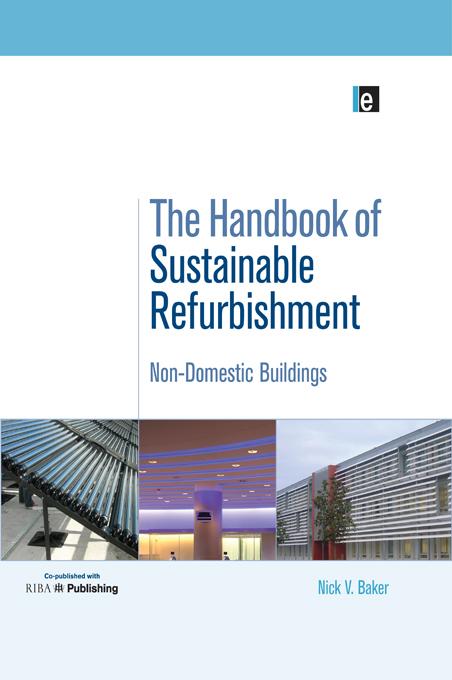
The refurbishment of existing buildings is a crucial yet often neglected subject within sustainable architecture; attention is usually focused on new buildings. Many old buildings waste large amounts of energy and provide poor internal conditions for occupants through poor lighting, poor ventilation, solar penetration and glare, and poor control of heating and cooling. Demolition is an option but the refurbishment alternative is increasingly seen as more sustainable in terms of architectural value, materials use, neighbourhood disruption and waste disposal. In addition, the potential impact of low energy refurbishment is much greater than that for new build since there are many more buildings already in existence than will be built in the next 10 - 20 years, the period over which many CO2 emission targets apply.
The Handbook of Sustainable Refurbishment: Non-Domestic Buildings offers architects, engineers and a wide range of building professionals practical advice, illustrated by real examples. It moves from principles of sustainable refurbishment to specific design and engineering guidance for a variety of circumstances. It emphasises the need for an integrated approach by showing how refurbishment measures interact with one another and with the occupants, and how performance is ultimately influenced by this interaction.
Betal enkelt med kort, Klarna, Apple Pay eller Google Pay. Ikke fornøyd? Du har alltid 14 dagers angrerett. Les mer i våre vilkår. Har du spørsmål, send oss en e-post på hello@memmo.org.
Memmo gjør det enklere å studere – uansett hvor du er i verden. Hos oss samler du pensumbøker og smarte studieverktøy på ett og samme sted: sammendrag, quizer, podkaster og flashcards. Og så Ted, din studiekompis som svarer på alt du lurer på. Over 50 000 studenter studerer allerede her – bygget for at du skal lære raskere og stresse mindre.