
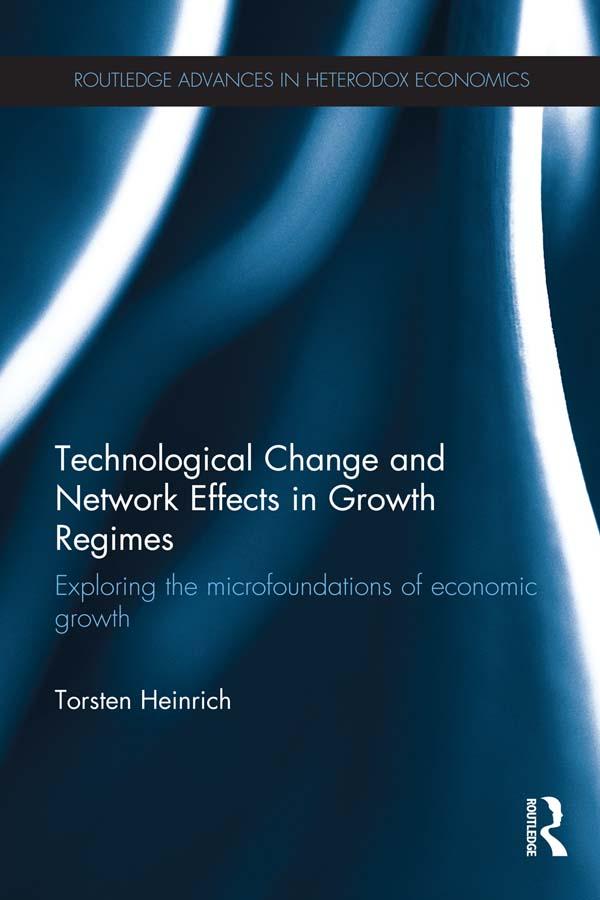
In this new volume it is argued that network effects are much more common than usually assumed, and that they have a profound impact on many aspects of economic systems, especially technological change and economic growth. The analysis and modelling of this interrelationship is the central focus of this book.
While there exists a vast body of literature on economic growth, the theories put forward so far have had limited success in explaining observed patterns of economic growth. ‘Growth cycles’ in particular continue to elude standard economic models, though evolutionary economics has made some progress. Seeking to fill the gap, Torsten Heinrich’s innovative approach uses microeconomics to explain heterogeneous sectoral dynamics on the meso level, and then aggregating these to observed macroeconomic growth rates. In this way, it is shown that an evolutionary model of technological change with network effects can explain not only commonly observed asymmetric industry structures, monopolies and oligopolies but also ‘growth cycles’.
The book includes a comprehensive account of the most influential economic growth theories, a discussion of the research on network effects as well as an introduction to the methodology, the model, and a case study on the recent emergence of information and communication technology.
This important new volume will be relevant to all those interested in theoretical economics, growth theory, innovation economics, agent based modelling and industry dynamics.
Betal enkelt med kort, Klarna, Apple Pay eller Google Pay. Ikke fornøyd? Du har alltid 14 dagers angrerett. Les mer i våre vilkår. Har du spørsmål, send oss en e-post på hello@memmo.org.
Memmo gjør det enklere å studere – uansett hvor du er i verden. Hos oss samler du pensumbøker og smarte studieverktøy på ett og samme sted: sammendrag, quizer, podkaster og flashcards. Og så Ted, din studiekompis som svarer på alt du lurer på. Over 50 000 studenter studerer allerede her – bygget for at du skal lære raskere og stresse mindre.