
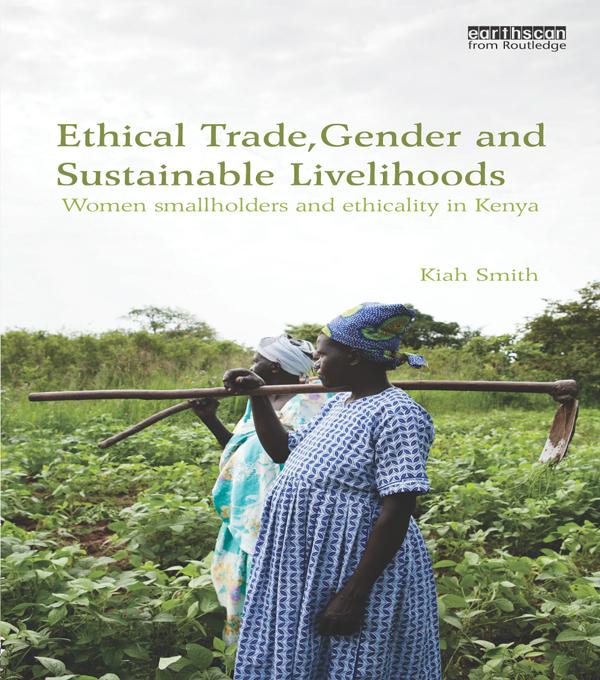
Fair and ethical trade is often criticized for being highly gendered, and for institutionalizing the ethical values of consumers, the priorities of NGOs and governments, and most of all, food retailers. But little is known about how women smallholder farmers experience diverse ethical standards, or whether and how standards reflect their values, local cultural and environmental contexts, or priorities for achieving sustainable livelihoods.
Linking gender, smallholder livelihoods and global ethical trade regulations, this book reveals that multiple understandings of social justice, environmental sustainability and well-being – or ethicality – exist in parallel to those institutionalized in ethical trade schemes. Through an in-depth case study of smallholder subsistence and French bean farming in Kenya, the book grounds the analysis of livelihoods, gender and ethical trade in women smallholders’ perspectives, links the macro level of markets with the micro level of livelihoods, and engenders relations of power, structure and agency in food networks.
It brings together disparate bodies of theory to illustrate the knowledge, strategies and values of women smallholder farmers that are often beyond the scope of ethical trade regulations. It also provides a challenging new vision for doing food systems research.
Betal enkelt med kort, Klarna, Apple Pay eller Google Pay. Ikke fornøyd? Du har alltid 14 dagers angrerett. Les mer i våre vilkår. Har du spørsmål, send oss en e-post på hello@memmo.org.
Memmo gjør det enklere å studere – uansett hvor du er i verden. Hos oss samler du pensumbøker og smarte studieverktøy på ett og samme sted: sammendrag, quizer, podkaster og flashcards. Og så Ted, din studiekompis som svarer på alt du lurer på. Over 50 000 studenter studerer allerede her – bygget for at du skal lære raskere og stresse mindre.