
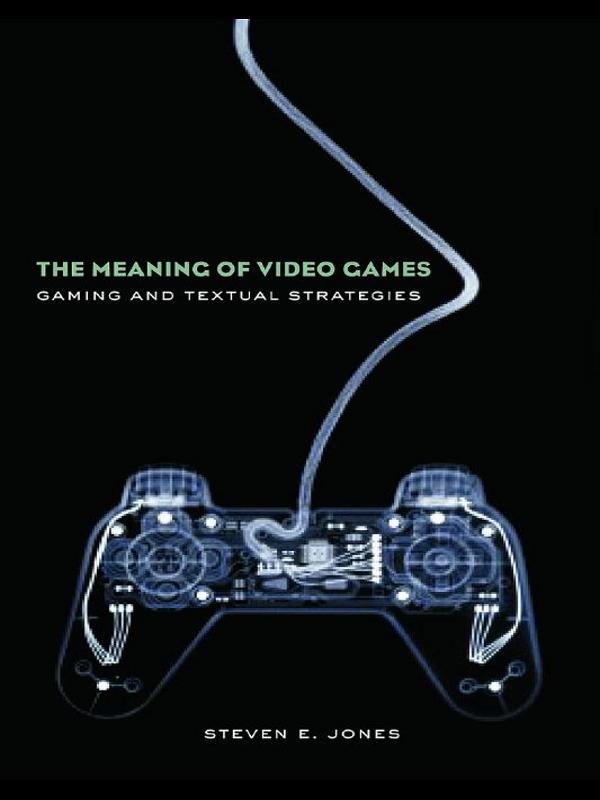
The Meaning of Video Games takes a textual studies approach to an increasingly important form of expression in today’s culture. It begins by assuming that video games are meaningful–not just as sociological or economic or cultural evidence, but in their own right, as cultural expressions worthy of scholarly attention. In this way, this book makes a contribution to the study of video games, but it also aims to enrich textual studies.
Early video game studies scholars were quick to point out that a game should never be reduced to merely its "story" or narrative content and they rightly insist on the importance of studying games as games. But here Steven E. Jones demonstrates that textual studies–which grows historically out of ancient questions of textual recension, multiple versions, production, reproduction, and reception–can fruitfully be applied to the study of video games. Citing specific examples such as Myst and Lost, Katamari Damacy, Halo, Façade, Nintendo’s Wii, and Will Wright’s Spore, the book explores the ways in which textual studies concepts–authorial intention, textual variability and performance, the paratext, publishing history and the social text–can shed light on video games as more than formal systems. It treats video games as cultural forms of expression that are received as they are played, out in the world, where their meanings get made.
Betal enkelt med kort, Klarna, Apple Pay eller Google Pay. Ikke fornøyd? Du har alltid 14 dagers angrerett. Les mer i våre vilkår. Har du spørsmål, send oss en e-post på hello@memmo.org.
Memmo gjør det enklere å studere – uansett hvor du er i verden. Hos oss samler du pensumbøker og smarte studieverktøy på ett og samme sted: sammendrag, quizer, podkaster og flashcards. Og så Ted, din studiekompis som svarer på alt du lurer på. Over 50 000 studenter studerer allerede her – bygget for at du skal lære raskere og stresse mindre.