
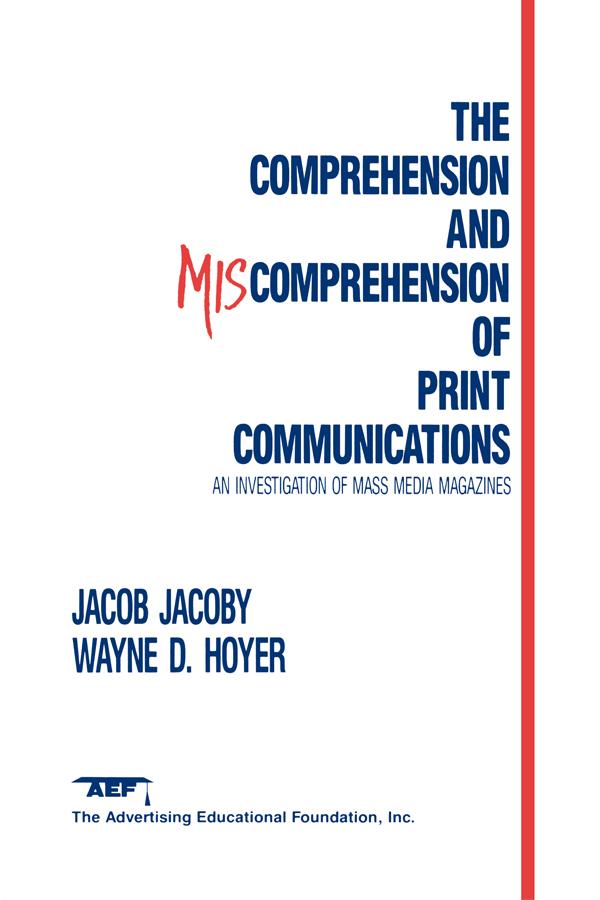
First Published in 1987. To writers and visualizers, this study sets a range of expectations for comprehension and miscomprehension—pointing the finger of caution that even what seems the simplest of language can be misunderstood, but also calling forth their best efforts, because this benchmark study shows that some communications can be much more successful than others and there is usually room for improvement. To advertisers, the study says that perhaps we often take comprehension too much for granted, being satisfied when consumers respond with something in the general area of our message, rather than in the precise area of what is meant. To academicians, the study gives reliable reference points for thought and dialogue among themselves and the advertising and publishing communities. It underlines what intuitive editors and writers have always known but have not always practiced: that words and ideas are fragile—handle with care if you hope to deliver them intact from one mind to another.
Betal enkelt med kort, Klarna, Apple Pay eller Google Pay. Ikke fornøyd? Du har alltid 14 dagers angrerett. Les mer i våre vilkår. Har du spørsmål, send oss en e-post på hello@memmo.org.
Memmo gjør det enklere å studere – uansett hvor du er i verden. Hos oss samler du pensumbøker og smarte studieverktøy på ett og samme sted: sammendrag, quizer, podkaster og flashcards. Og så Ted, din studiekompis som svarer på alt du lurer på. Over 50 000 studenter studerer allerede her – bygget for at du skal lære raskere og stresse mindre.
Du vil kanskje også like
Kjøp boken0