
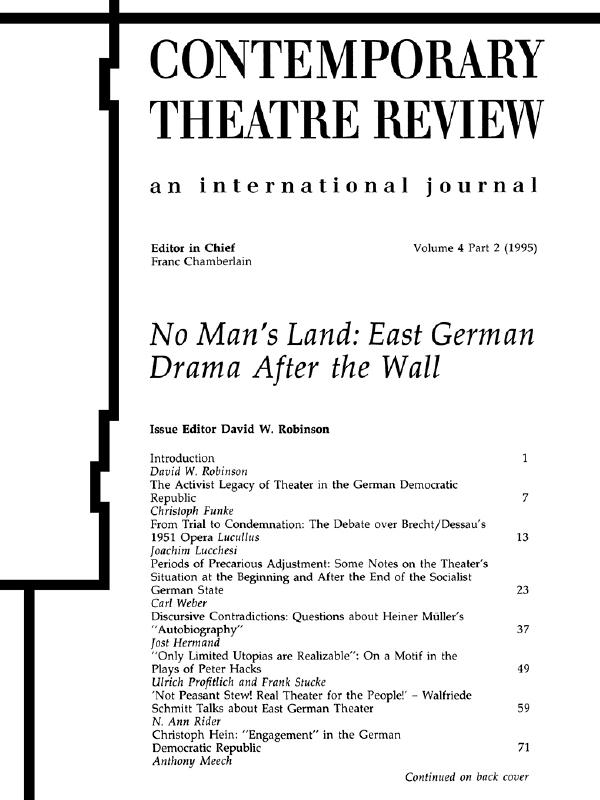
The political events of "annus mirabilis" 1989 marked a rare turning point in world history, but the significance of the year for German literary history is unique. As the 40-year-old German Democratic Republic ceased to exist, so too did the special circumstances which had fostered a literature separate from and in competition with that of the Federal Republic of Germany. A new period of literary history was delimited almost overnight: Germany Democratic Republic literature now was something to be examined as a whole, cultural movement. At the same time, the literary traditions of the German Democratic Republic have continued to influence the contemporary cultural scene, often in ways that are only gradually becoming clear.
The essays, memoirs, and plays collected in this special issue of Contemporary Theatre Review represent an early attempt to assess and reassess one of the German Democratic Republic's richest cultural domains: its theatre. Contributors include David W. Robinson, C
Betal enkelt med kort, Klarna, Apple Pay eller Google Pay. Ikke fornøyd? Du har alltid 14 dagers angrerett. Les mer i våre vilkår. Har du spørsmål, send oss en e-post på hello@memmo.org.
Memmo gjør det enklere å studere – uansett hvor du er i verden. Hos oss samler du pensumbøker og smarte studieverktøy på ett og samme sted: sammendrag, quizer, podkaster og flashcards. Og så Ted, din studiekompis som svarer på alt du lurer på. Over 50 000 studenter studerer allerede her – bygget for at du skal lære raskere og stresse mindre.