
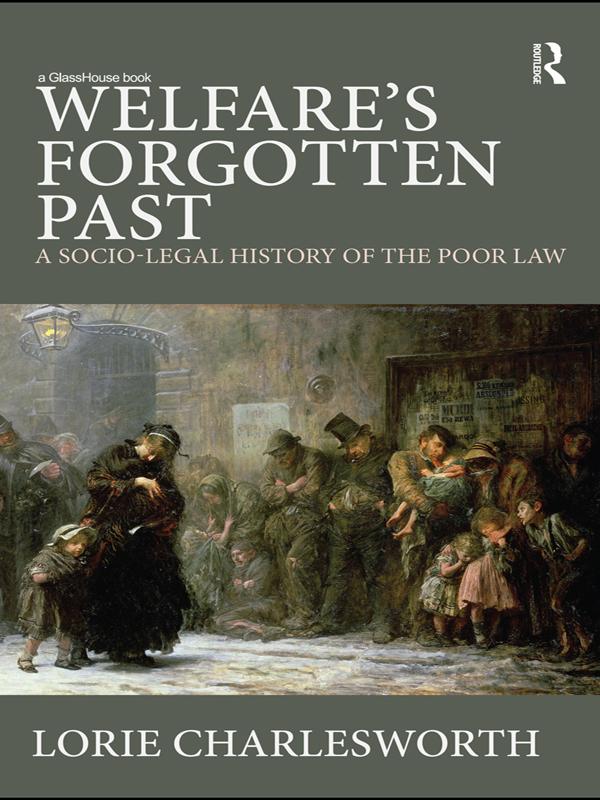
That ‘poor law was law’ is a fact that has slipped from the consciousness of historians of welfare in England and Wales, and in North America. Welfare's Forgotten Past remedies this situation by tracing the history of the legal right of the settled poor to relief when destitute. Poor law was not simply local custom, but consisted of legal rights, duties and obligations that went beyond social altruism. This legal ‘truth’ is, however, still ignored or rejected by some historians, and thus ‘lost’ to social welfare policy-makers. This forgetting or minimising of a legal, enforceable right to relief has not only led to a misunderstanding of welfare’s past; it has also contributed to the stigmatisation of poverty, and the emergence and persistence of the idea that its relief is a 'gift' from the state.
Documenting the history and the effects of this forgetting, whilst also providing a ‘legal’ history of welfare, Lorie Charlesworth argues that it is timely for social policy-makers and reformists – in Britain, the United States and elsewhere – to reconsider an alternative welfare model, based on the more positive, legal aspects of welfare’s 400-year legal history.
Betal enkelt med kort, Klarna, Apple Pay eller Google Pay. Ikke fornøyd? Du har alltid 14 dagers angrerett. Les mer i våre vilkår. Har du spørsmål, send oss en e-post på hello@memmo.org.
Memmo gjør det enklere å studere – uansett hvor du er i verden. Hos oss samler du pensumbøker og smarte studieverktøy på ett og samme sted: sammendrag, quizer, podkaster og flashcards. Og så Ted, din studiekompis som svarer på alt du lurer på. Over 50 000 studenter studerer allerede her – bygget for at du skal lære raskere og stresse mindre.