
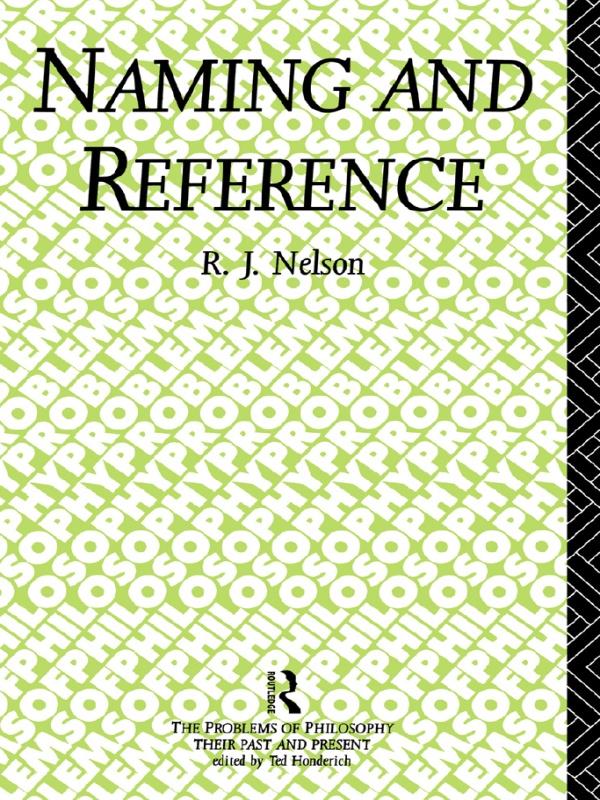
The question of how language relates to the world is one of the most important problems of philosophy. What the word `God' refers to and the question `Does God exist?' are clearly linked. The existence or non-existence of God (or electrons or unicorns) is directly related to the issue of what and how a name names. Naming and Reference tackles the challenge of explaining the referring power of names. More specifically it explores the reference of lexical terms (especially proper names and pronouns) and the issue of empty or speculative names such as `Satan' and `leptons'. The lack of semantics of such terms is a serious difficulty for linguistics, cognitive science and epistemology. In the first half of the book, a survey of the history of the subject is made from Locke to Kripke and Fodor. The second half contains a theory of reference which takes seriously the causal notion of reference, while at the same time preserving Frege's distinction between sense and reference. The algorithmic theory of reference that results treats reference in explicitly non-semantical terms. It incorporates or reflects the latest work in computational logic, cognitive science, philosophy of mind, linguistics and brain biology.
Betal enkelt med kort, Klarna, Apple Pay eller Google Pay. Ikke fornøyd? Du har alltid 14 dagers angrerett. Les mer i våre vilkår. Har du spørsmål, send oss en e-post på hello@memmo.org.
Memmo gjør det enklere å studere – uansett hvor du er i verden. Hos oss samler du pensumbøker og smarte studieverktøy på ett og samme sted: sammendrag, quizer, podkaster og flashcards. Og så Ted, din studiekompis som svarer på alt du lurer på. Over 50 000 studenter studerer allerede her – bygget for at du skal lære raskere og stresse mindre.
Du vil kanskje også like
Kjøp boken0