
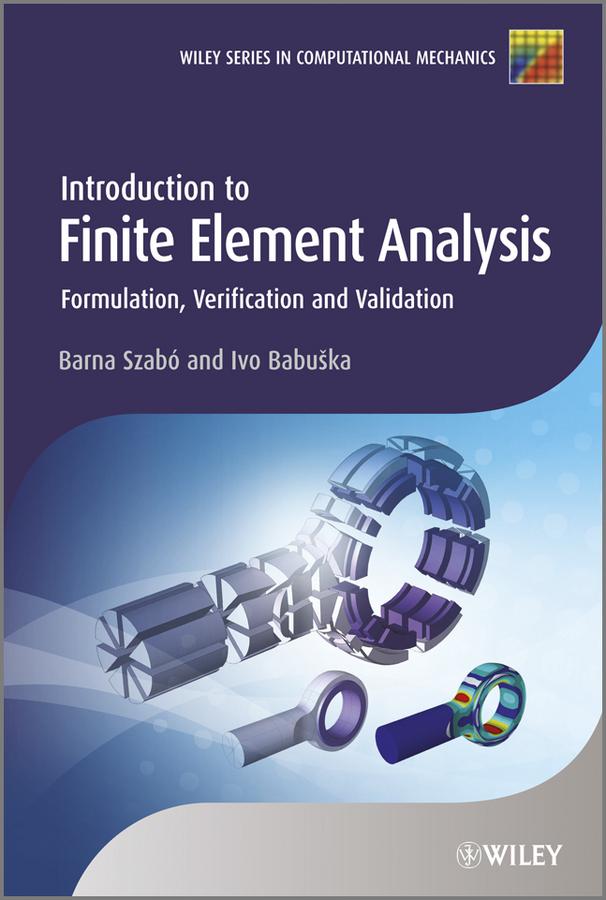
Whenever numerical simulation is employed in connection with engineering decision-making, there is an implied expectation of reliability: one cannot base decisions on computed information without believing that information is reliable enough to support those decisions. Using mathematical models to show the reliability of computer-generated information is an essential part of any modelling effort.
Giving users of finite element analysis (FEA) software an introduction to verification and validation procedures, this book thoroughly covers the fundamentals of assuring reliability in numerical simulation. The renowned authors systematically guide readers through the basic theory and algorithmic structure of the finite element method, using helpful examples and exercises throughout.
- Delivers the tools needed to have a working knowledge of the finite element method
- Illustrates the concepts and procedures of verification and validation
- Explains the process of conceptualization supported by virtual experimentation
- Describes the convergence characteristics of the h-, p- and hp-methods
- Covers the hierarchic view of mathematical models and finite element spaces
- Uses examples and exercises which illustrate the techniques and procedures of quality assurance
- Ideal for mechanical and structural engineering students, practicing engineers and applied mathematicians
- Includes parameter-controlled examples of solved problems in a companion website (www.wiley.com/go/szabo)
Betal enkelt med kort, Klarna, Apple Pay eller Google Pay. Ikke fornøyd? Du har alltid 14 dagers angrerett. Les mer i våre vilkår. Har du spørsmål, send oss en e-post på hello@memmo.org.
Memmo gjør det enklere å studere – uansett hvor du er i verden. Hos oss samler du pensumbøker og smarte studieverktøy på ett og samme sted: sammendrag, quizer, podkaster og flashcards. Og så Ted, din studiekompis som svarer på alt du lurer på. Over 50 000 studenter studerer allerede her – bygget for at du skal lære raskere og stresse mindre.