
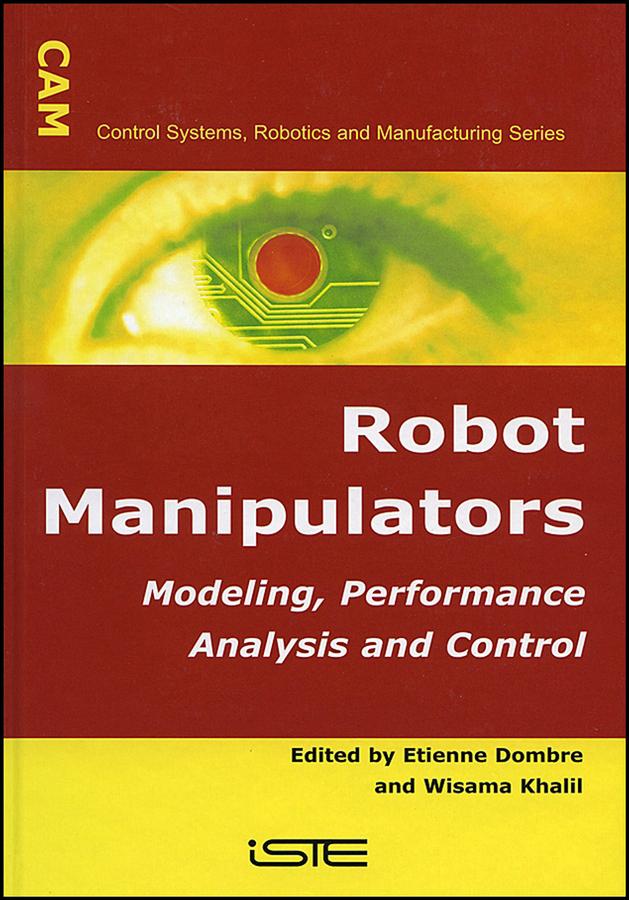
This book presents the most recent research results on modeling and control of robot manipulators.
- Chapter 1 gives unified tools to derive direct and inverse geometric, kinematic and dynamic models of serial robots and addresses the issue of identification of the geometric and dynamic parameters of these models.
- Chapter 2 describes the main features of serial robots, the different architectures and the methods used to obtain direct and inverse geometric, kinematic and dynamic models, paying special attention to singularity analysis.
- Chapter 3 introduces global and local tools for performance analysis of serial robots.
- Chapter 4 presents an original optimization technique for point-to-point trajectory generation accounting for robot dynamics.
- Chapter 5 presents standard control techniques in the joint space and task space for free motion (PID, computed torque, adaptive dynamic control and variable structure control) and constrained motion (compliant force-position control).
- In Chapter 6, the concept of vision-based control is developed and Chapter 7 is devoted to specific issue of robots with flexible links. Efficient recursive Newton-Euler algorithms for both inverse and direct modeling are presented, as well as control methods ensuring position setting and vibration damping.
Betal enkelt med kort, Klarna, Apple Pay eller Google Pay. Ikke fornøyd? Du har alltid 14 dagers angrerett. Les mer i våre vilkår. Har du spørsmål, send oss en e-post på hello@memmo.org.
Memmo gjør det enklere å studere – uansett hvor du er i verden. Hos oss samler du pensumbøker og smarte studieverktøy på ett og samme sted: sammendrag, quizer, podkaster og flashcards. Og så Ted, din studiekompis som svarer på alt du lurer på. Over 50 000 studenter studerer allerede her – bygget for at du skal lære raskere og stresse mindre.