
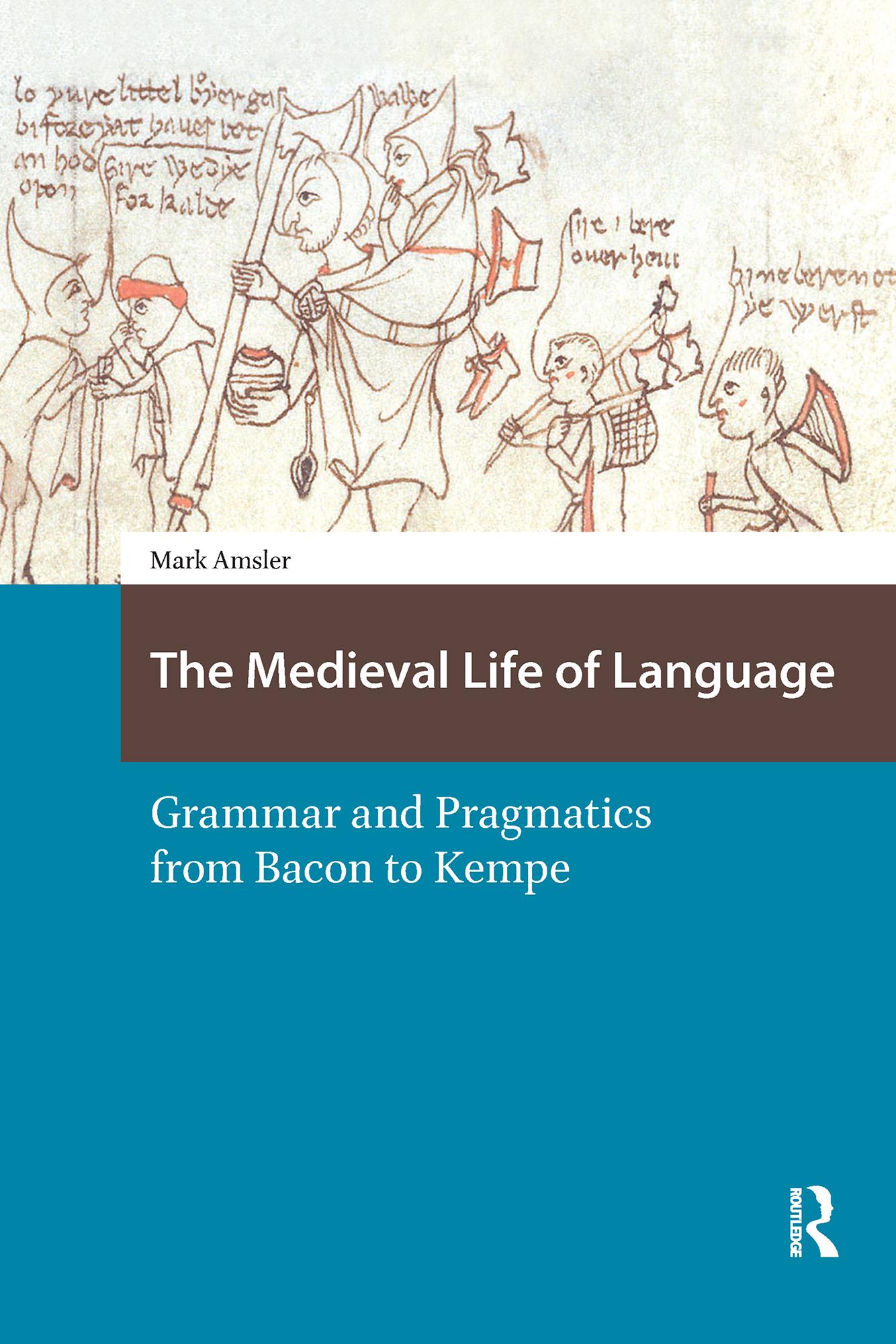
The Medieval Life of Language: Grammar and Pragmatics from Bacon to Kempe explores the complex history of medieval pragmatic theory and ideas and metapragmatic awareness across social discourses. Pragmatic thinking about language and communication is revealed in grammar, semiotics, philosophy, and literature. Part historical reconstruction, part social history, part language theory, Amsler supplements the usual materials for the history of medieval linguistics and discusses the pragmatic implications of grammatical treatises on the interjection, Bacon’s sign theory, logic texts, Chaucer’s poetry, inquisitors’ accounts of heretic speech, and life-writing by William Thorpe and Margery Kempe. Medieval and contemporary pragmatic theory are contrasted in terms of their philosophical and linguistic orientations. Aspects of medieval pragmatic theory and practice, especially polysemy, equivocation, affective speech, and recontextualization, show how pragmatic discourse informed social controversies and attitudes toward sincere, vague, and heretical speech. Relying on Bakhtinian dialogism, critical discourse analysis, and conversation analysis, Amsler situates a key period in the history of linguistics within broader social and discursive fields of practice.
Betal enkelt med kort, Klarna, Apple Pay eller Google Pay. Ikke fornøyd? Du har alltid 14 dagers angrerett. Les mer i våre vilkår. Har du spørsmål, send oss en e-post på hello@memmo.org.
Memmo gjør det enklere å studere – uansett hvor du er i verden. Hos oss samler du pensumbøker og smarte studieverktøy på ett og samme sted: sammendrag, quizer, podkaster og flashcards. Og så Ted, din studiekompis som svarer på alt du lurer på. Over 50 000 studenter studerer allerede her – bygget for at du skal lære raskere og stresse mindre.