
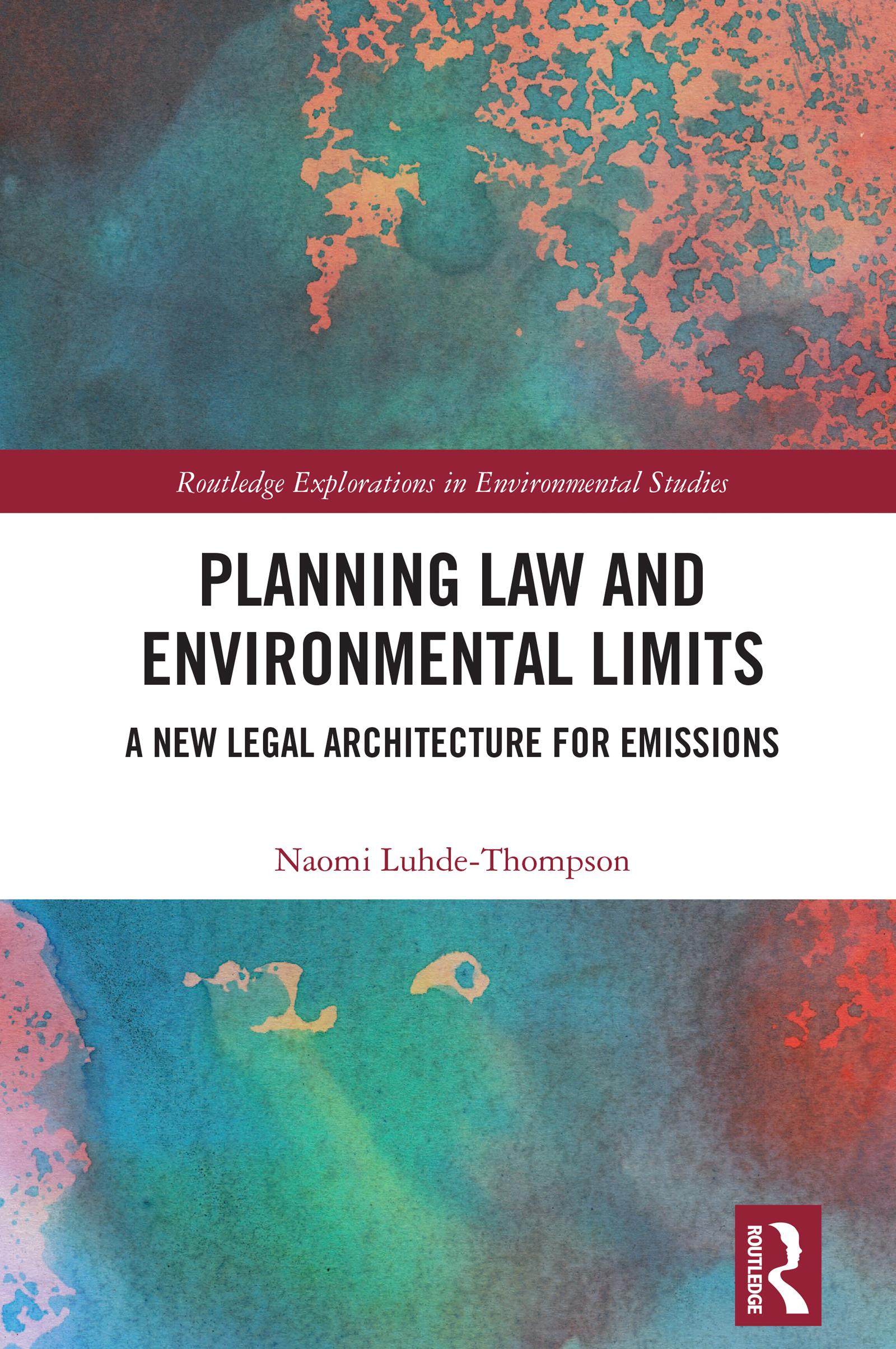
This book explores the role of planning law in balancing the dilemma of resource extraction with the recognition of greenhouse gas emission limits.
Naomi Luhde-Thompson explores how planning law, which is one of the strongest forms of environmental regulation in the UK, has failed to incorporate environmental limits into decisions. Environmental limits are broadly understood as the point at which an irreversible change occurs in a system, providing a measure by which to assess development and to test whether or not these limits might be overrun. Combining theoretical perspectives with experiential practice, the book draws upon hydrocarbon extraction to analyse and interrogate the functionality of current decision-making processes elated to planning law and climate change mitigation. It goes on to propose an amended system that expands the foundational value of public interest in planning law, recommending strategies to incorporate environmental limits, in both strategic planning and decisions.
Planning Law and Environmental Limits will be of use to lawyers and policymakers, as well as to researchers, academics, and students interested in climate change, planning, and environmental law.
Betal enkelt med kort, Klarna, Apple Pay eller Google Pay. Ikke fornøyd? Du har alltid 14 dagers angrerett. Les mer i våre vilkår. Har du spørsmål, send oss en e-post på hello@memmo.org.
Memmo gjør det enklere å studere – uansett hvor du er i verden. Hos oss samler du pensumbøker og smarte studieverktøy på ett og samme sted: sammendrag, quizer, podkaster og flashcards. Og så Ted, din studiekompis som svarer på alt du lurer på. Over 50 000 studenter studerer allerede her – bygget for at du skal lære raskere og stresse mindre.