
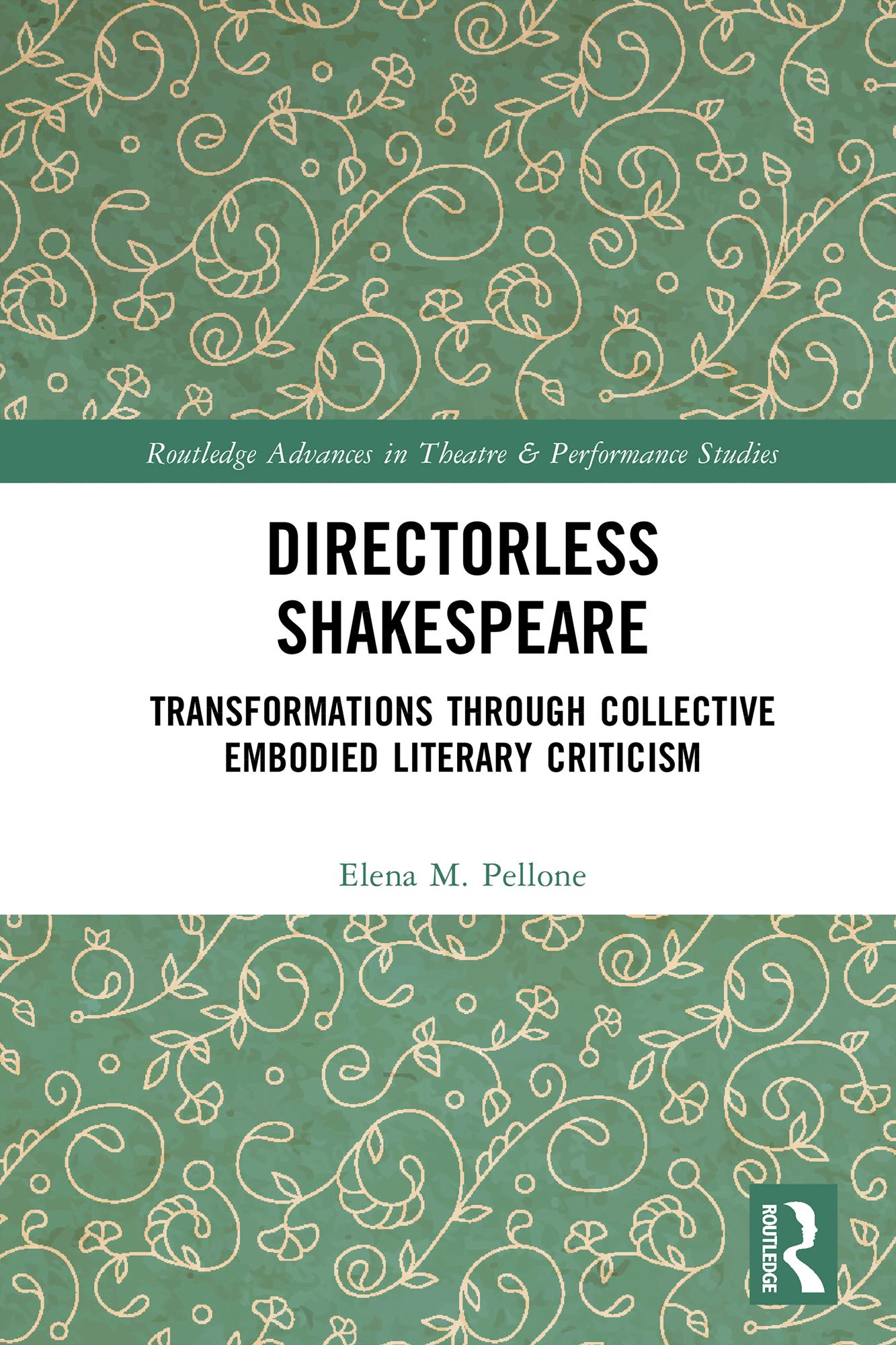
Challenging received scholarship on the practice of Shakespeare’s theatre, this book displaces a contemporary cultural bias towards leadership models to reconsider possibilities of working in a non-hierarchical and inclusive creative theatrical practice. It offers ways of restoring to actors a sense of what the existentialists termed “autonomy” that Shakespeare’s company would have embodied. Against a critical account of two major Shakespeare playhouses – Shakespeare’s Globe, London and the American Shakespeare Center – the book describes the original practice-based research by Anərkē Shakespeare and V.enice S.hakespeare C.ompany without a controlling director. Their staging of three directorless Shakespeare plays, and his narrative poem The Rape of Lucrece, with diverse actors, performance spaces, languages and countries, explores multilingual, intersectional, cross-disciplinary and international possibilities of early modern performance and study. Directorless Shakespeare as “Embodied Literary Criticism” releases the dialogical forces of Shakespeare’s texts, which are more fully served by the centrifugal force of the collective ensemble rather than the centripetal force of the single director. It allows texts to speak fully and multiply, in democratic exchange with an audience, liberated from directorial or theoretically driven concepts.
Directorless Shakespeare will be of great interest to students and scholars in theatre and performance studies, professional practitioners and historians.
Betal enkelt med kort, Klarna, Apple Pay eller Google Pay. Ikke fornøyd? Du har alltid 14 dagers angrerett. Les mer i våre vilkår. Har du spørsmål, send oss en e-post på hello@memmo.org.
Memmo gjør det enklere å studere – uansett hvor du er i verden. Hos oss samler du pensumbøker og smarte studieverktøy på ett og samme sted: sammendrag, quizer, podkaster og flashcards. Og så Ted, din studiekompis som svarer på alt du lurer på. Over 50 000 studenter studerer allerede her – bygget for at du skal lære raskere og stresse mindre.