
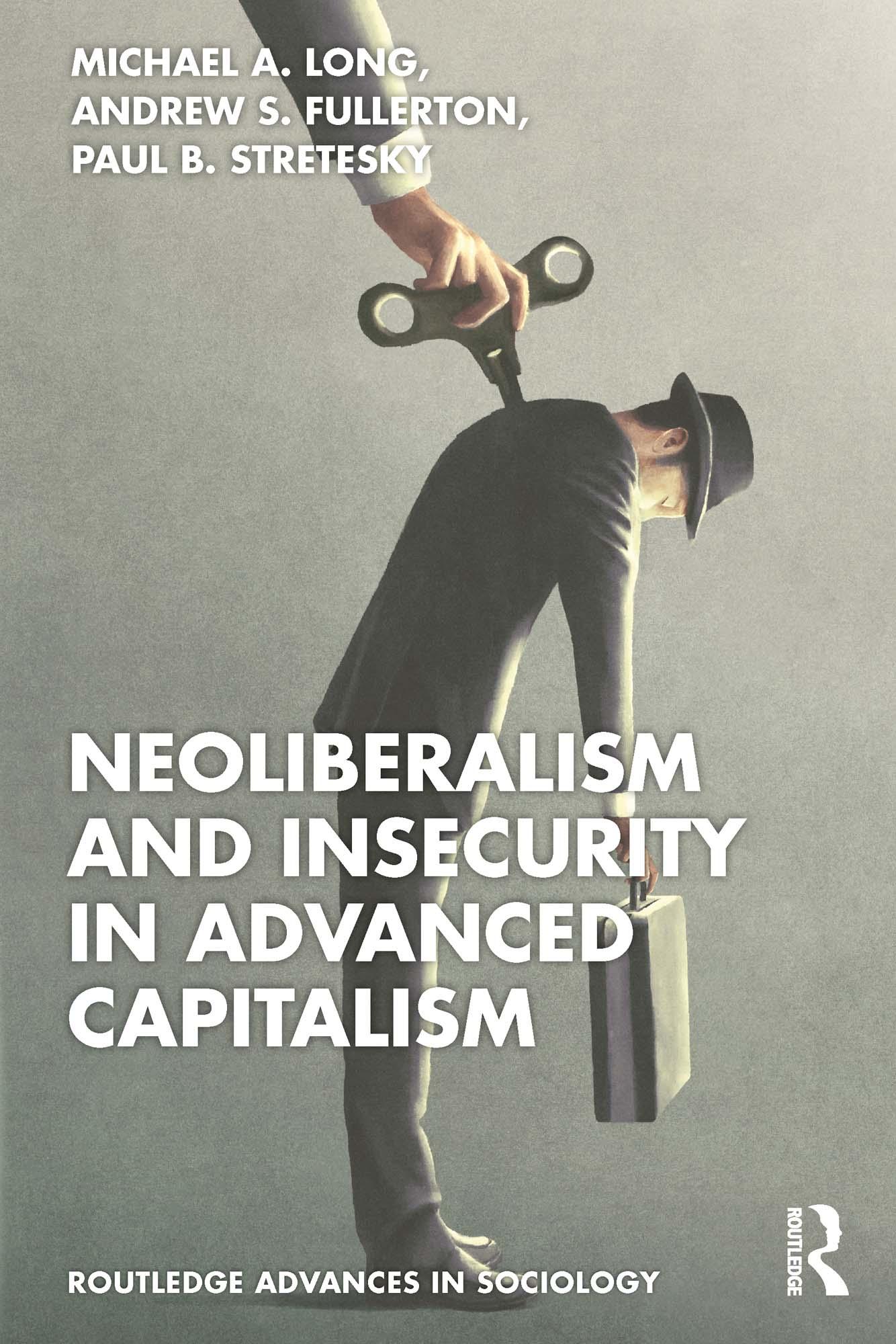
This book examines the relationship between neoliberalism and insecurity, beginning with the post‑World War II period and continuing up through the present. Neoliberalism – the dominant political economic perspective that elevates competition above all else at both the structural and individual levels – has increased the amount of insecurity (e.g., food, energy, job) across the world. It provides a theoretical and empirical analysis of how and why neoliberalism and insecurity have become intertwined over the last half century.
The book takes a novel approach to the study of neoliberalism, insecurity, and their intersection. First, in addition to examining specific types of insecurity, the overall concept of insecurity is defined and theorized as a fundamental part of neoliberal capitalism. Second, to help bypass the structural versus individual binary that has come to characterize much of the neoliberalism literature, a field‑theoretic framework, heavily influenced by the work of Pierre Bourdieu, is employed.
As such, it will be of great interest for researchers in neoliberalism, insecurity, and Bourdieu’s theory of practice, including advanced undergraduate students and graduate scholars from sociology, anthropology, geography, political science, and public health.
Betal enkelt med kort, Klarna, Apple Pay eller Google Pay. Ikke fornøyd? Du har alltid 14 dagers angrerett. Les mer i våre vilkår. Har du spørsmål, send oss en e-post på hello@memmo.org.
Memmo gjør det enklere å studere – uansett hvor du er i verden. Hos oss samler du pensumbøker og smarte studieverktøy på ett og samme sted: sammendrag, quizer, podkaster og flashcards. Og så Ted, din studiekompis som svarer på alt du lurer på. Over 50 000 studenter studerer allerede her – bygget for at du skal lære raskere og stresse mindre.