
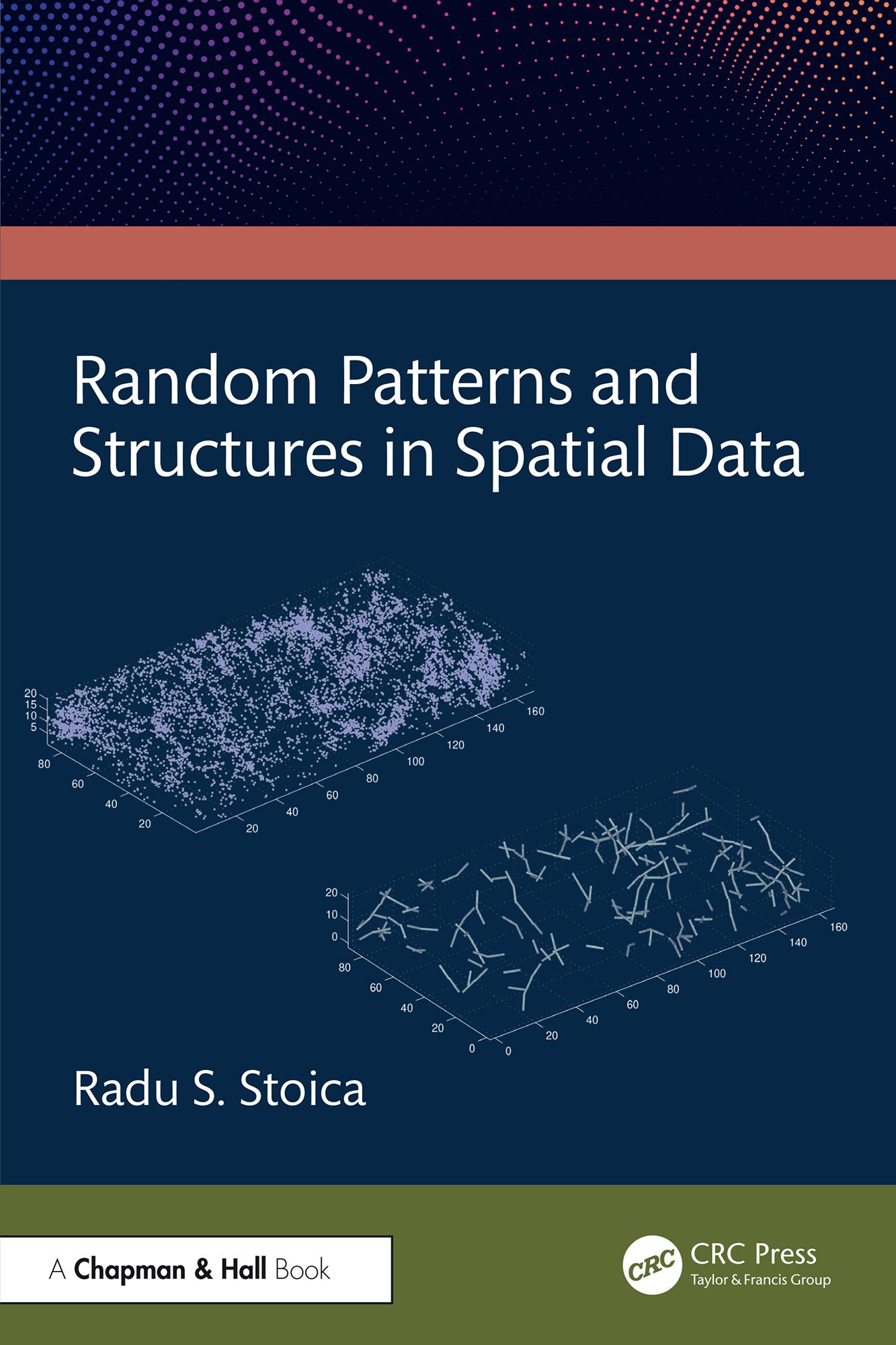
The book presents a general mathematical framework able to detect and to characterise, from a morphological and statistical perspective, patterns hidden in spatial data. The mathematical tools employed are Gibbs Markov processes, mainly marked point procesess with interaction, which permits us to reduce the complexity of the pattern. It presents the framework, step by step, in three major parts: modeling, simulation, and inference. Each of these parts contains a theoretical development followed by applications and examples.
Features
- Presents mathematical foundations for tackling pattern detection and characterisation in spatial data using marked Gibbs point processes with interactions
- Includes application examples from cosmology, environmental sciences, geology, and social networks
- Presents theoretical and practical details for the presented algorithms in order to be correctly and efficiently used
- Provides access to C++ and R code to encourage the reader to experiment and to develop new ideas
- Includes references and pointers to mathematical and applied literature to encourage further study
Random Patterns and Structures in Spatial Data is primarily aimed at researchers in mathematics, statistics, and the above-mentioned application domains. It is accessible for advanced undergraduate and graduate students and thus could be used to teach a course. It will be of interest to any scientific researcher interested in formulating a mathematical answer to the always challenging question: what is the pattern hidden in the data?
Betal enkelt med kort, Klarna, Apple Pay eller Google Pay. Ikke fornøyd? Du har alltid 14 dagers angrerett. Les mer i våre vilkår. Har du spørsmål, send oss en e-post på hello@memmo.org.
Memmo gjør det enklere å studere – uansett hvor du er i verden. Hos oss samler du pensumbøker og smarte studieverktøy på ett og samme sted: sammendrag, quizer, podkaster og flashcards. Og så Ted, din studiekompis som svarer på alt du lurer på. Over 50 000 studenter studerer allerede her – bygget for at du skal lære raskere og stresse mindre.