
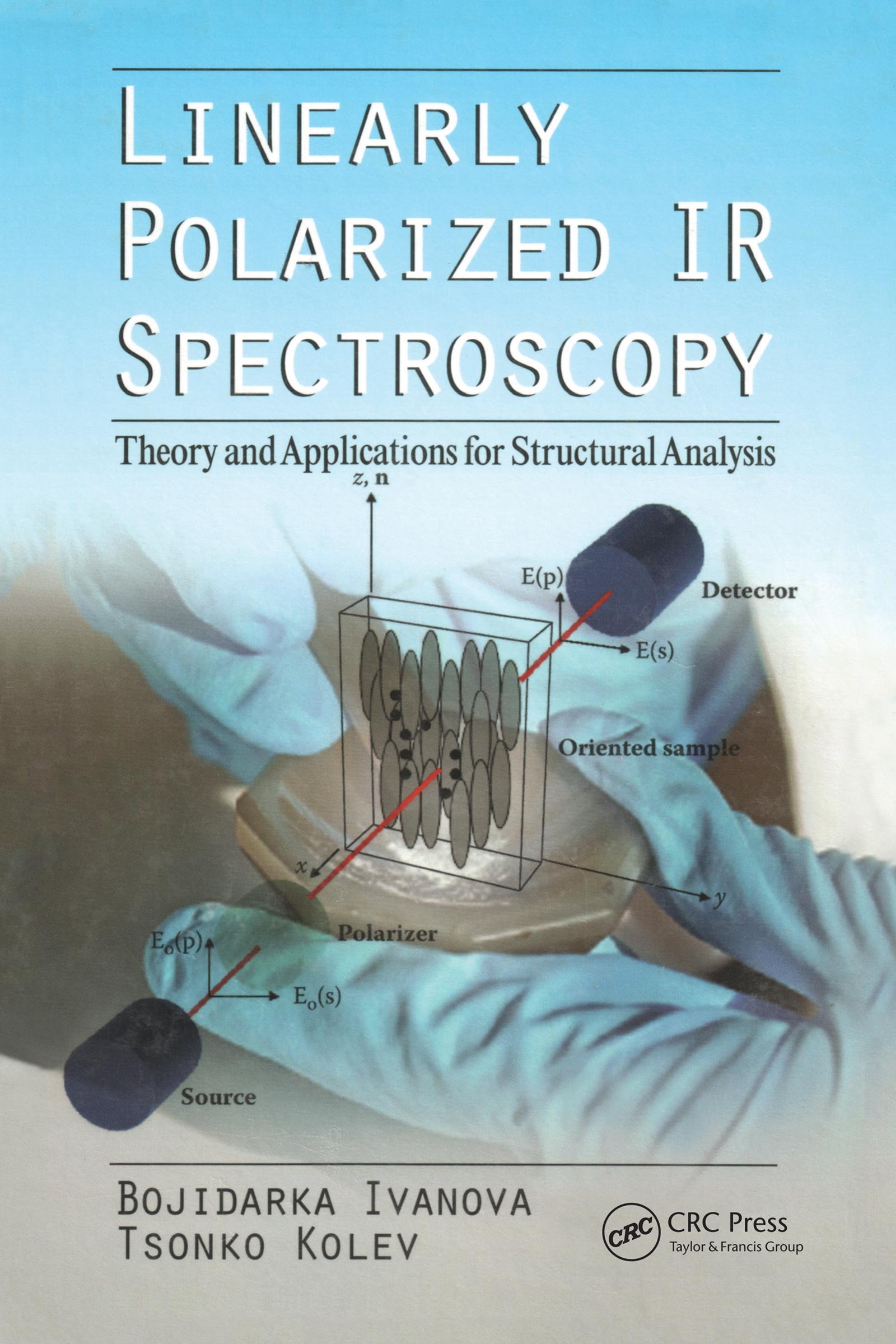
A technique that is useful in the study of pharmaceutical products and biological molecules, polarization IR spectroscopy has undergone continuous development since it first emerged almost 100 years ago. Capturing the state of the science as it exists today, Linearly Polarized IR Spectroscopy: Theory and Applications for Structural Analysis demonstrates how the technique can be properly utilized to obtain important information about the structure and spectral properties of oriented compounds.
The book starts with the theoretical basis of linear-dichroic infrared (IR-LD) spectroscopy and then moves on to examine the background of the orientation method of colloid suspensions in a nematic host. It explores the orientation procedure itself, experimental design, and mathematical tools for the interpretation of the IR spectroscopic patterns. Next, the authors describe the structural elucidation of inorganic and organic compounds and glasses. Finally, they discuss applications in pharmaceutical analysis and the chemistry of dyes. Filled with more than 140 illustrations along with a color insert, the book explains both the scope of the polarized IR spectroscopy method as well as its limitations.
A powerful source of information not only for specialists in IR spectroscopy, but also for those working in the field of structural analysis, this volume moves the field closer to developing an inherently classical method for the structural characterization of compounds.
Betal enkelt med kort, Klarna, Apple Pay eller Google Pay. Ikke fornøyd? Du har alltid 14 dagers angrerett. Les mer i våre vilkår. Har du spørsmål, send oss en e-post på hello@memmo.org.
Memmo gjør det enklere å studere – uansett hvor du er i verden. Hos oss samler du pensumbøker og smarte studieverktøy på ett og samme sted: sammendrag, quizer, podkaster og flashcards. Og så Ted, din studiekompis som svarer på alt du lurer på. Over 50 000 studenter studerer allerede her – bygget for at du skal lære raskere og stresse mindre.