
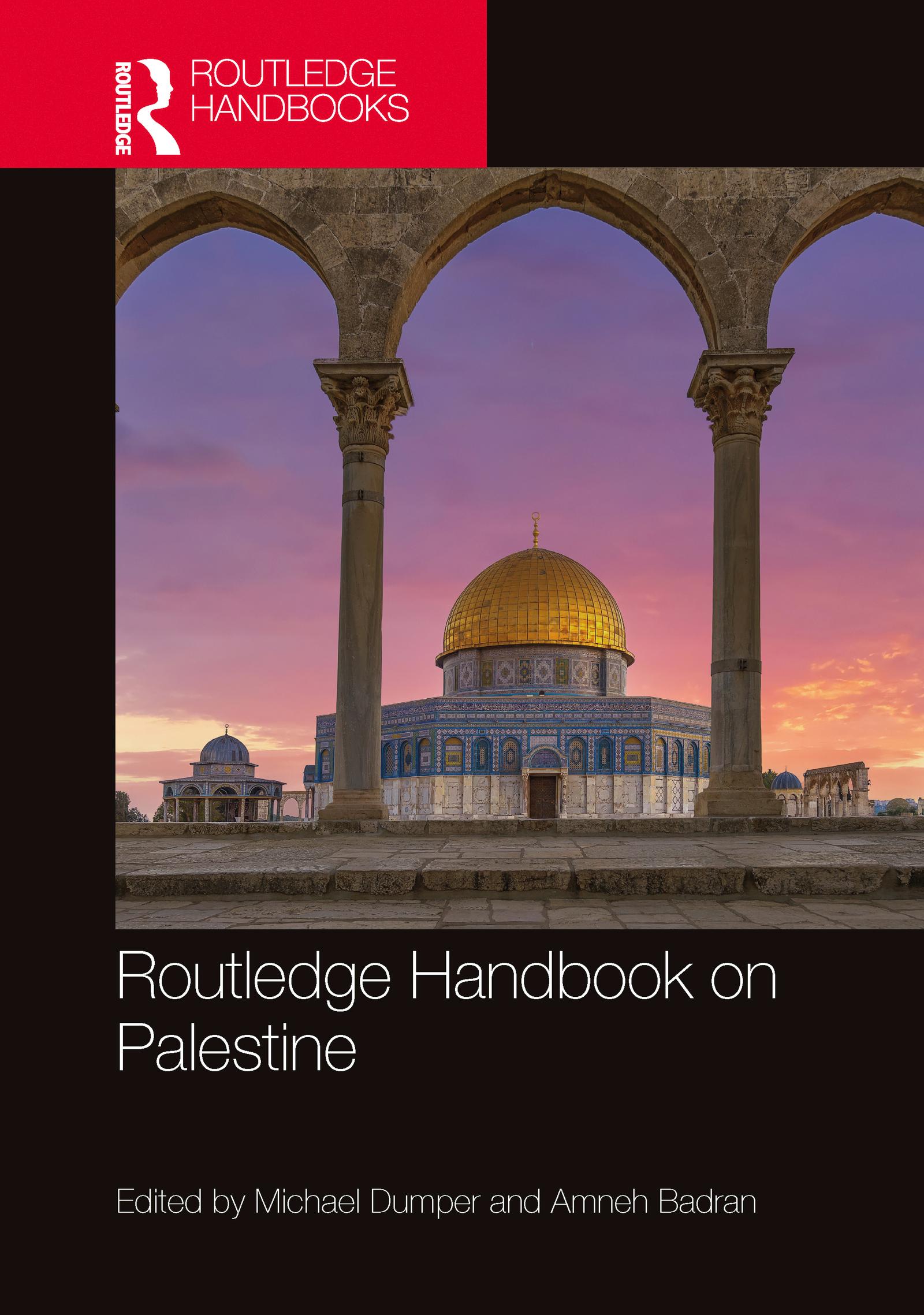
This Handbook provides a broad overview of Palestinian history, society, politics, and culture across different contexts and periods, revealing the rich and varied dimensions of Palestine.
To capture the diversity of Palestinian scholarship and to introduce readers to a mix of approaches and perspectives, both internationally established and emerging Palestinian scholars have contributed. The Handbook attempts to avoid narrowly framing Palestine around the Israeli-Palestinian conflict, incorporating postcolonial approaches attentive to a broader range of (hitherto overlooked) actors. While a significant proportion of the Handbook examines the contemporary period, it is divided up into four sections that together provide a detailed overview of the main developments in the region:
- A historical section that contextualizes the complex historical formation of contemporary Palestine – perhaps best regarded as a country but not yet a state
- A section exploring the society, geography, economy, and identity of Palestine
- A section on the political significance of Palestine, covering the dynamics between Jewish nationalism (Zionism) and Palestinian nationalism
- A final section on culture, touching on architecture, literature, music, cuisine, education, and contemporary art
Providing a deep analysis of the Palestinian perspective, the Handbook will prove valuable reading for anyone interested in the history, politics and society of Palestine and the Middle East.
Betal enkelt med kort, Klarna, Apple Pay eller Google Pay. Ikke fornøyd? Du har alltid 14 dagers angrerett. Les mer i våre vilkår. Har du spørsmål, send oss en e-post på hello@memmo.org.
Memmo gjør det enklere å studere – uansett hvor du er i verden. Hos oss samler du pensumbøker og smarte studieverktøy på ett og samme sted: sammendrag, quizer, podkaster og flashcards. Og så Ted, din studiekompis som svarer på alt du lurer på. Over 50 000 studenter studerer allerede her – bygget for at du skal lære raskere og stresse mindre.