
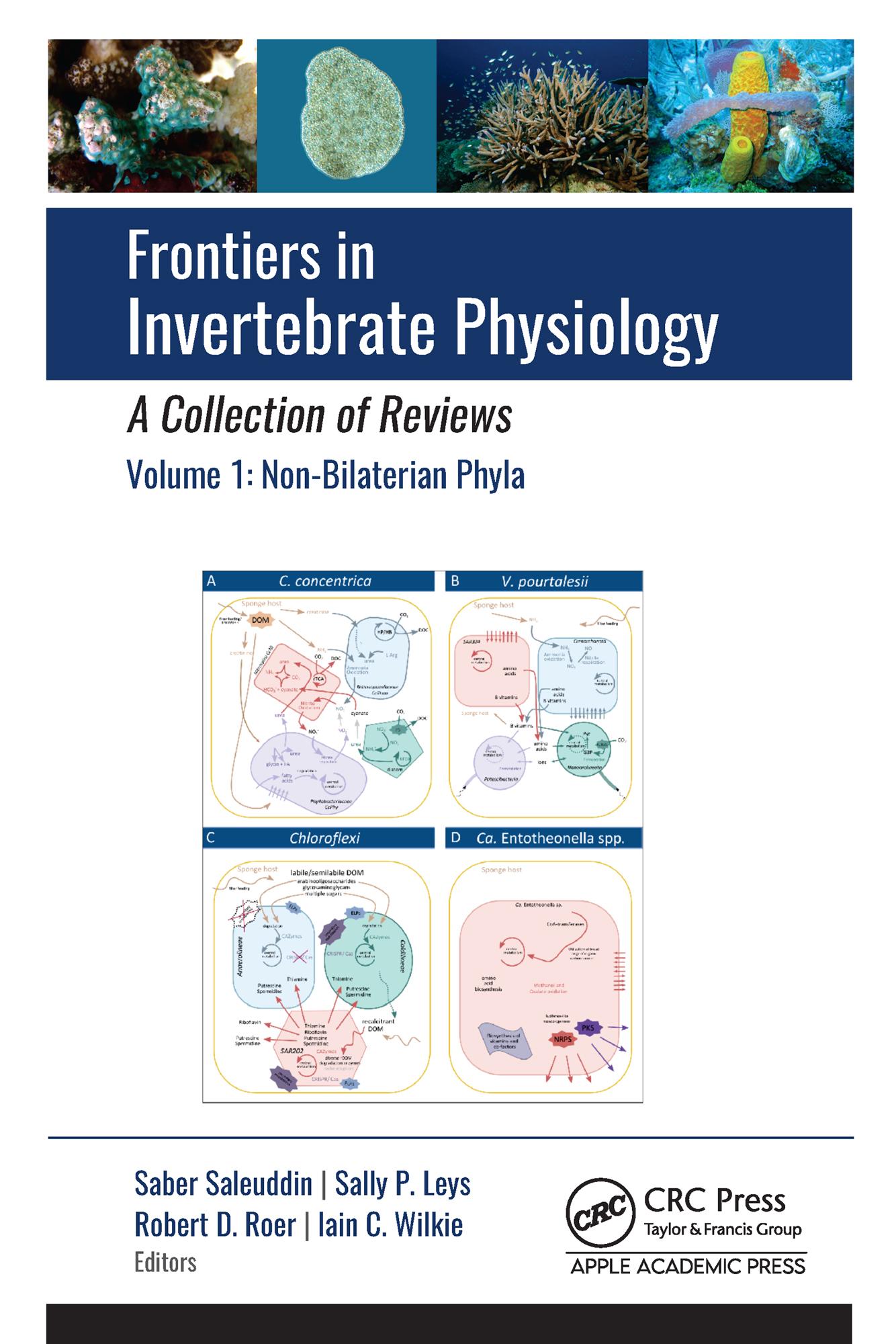
This new 3-volume set provides informative reviews on the physiology of sponges, cnidarians, round and flat worms, annelids, echinoderms, and crustaceans, advancing our knowledge of the physiology of these major invertebrate groups (Phyla). Invertebrates exhibit the largest number of species and occupy virtually every conceivable ecological niche. They are economically important in food chains, they recycle organic waste, and they are crucial pollinators of plants and sources of food. They are also medically relevant as parasites that cause major diseases in both humans and livestock.
Volume 1 looks at non-Bilaterians (sponges, cnidarians, placozoans). The focus on sponge biology has recently been on symbiosis, nutrient uptake, and sensory biology. The section on cnidarians covers biomineralization, the nervous system, and development. The biology of placozoans is described in depth, including the role of neuropeptides in feeding.
Volume 2 and covers crustacean physiology and diverse physiological topics, ranging from molting, respiration, water balance, biomineralization, bioreceptors, and temperature regulation to the land adaptation of terrestrial crustaceans. Echinoderms and annelids are covered in Volume 3.
Betal enkelt med kort, Klarna, Apple Pay eller Google Pay. Ikke fornøyd? Du har alltid 14 dagers angrerett. Les mer i våre vilkår. Har du spørsmål, send oss en e-post på hello@memmo.org.
Memmo gjør det enklere å studere – uansett hvor du er i verden. Hos oss samler du pensumbøker og smarte studieverktøy på ett og samme sted: sammendrag, quizer, podkaster og flashcards. Og så Ted, din studiekompis som svarer på alt du lurer på. Over 50 000 studenter studerer allerede her – bygget for at du skal lære raskere og stresse mindre.