
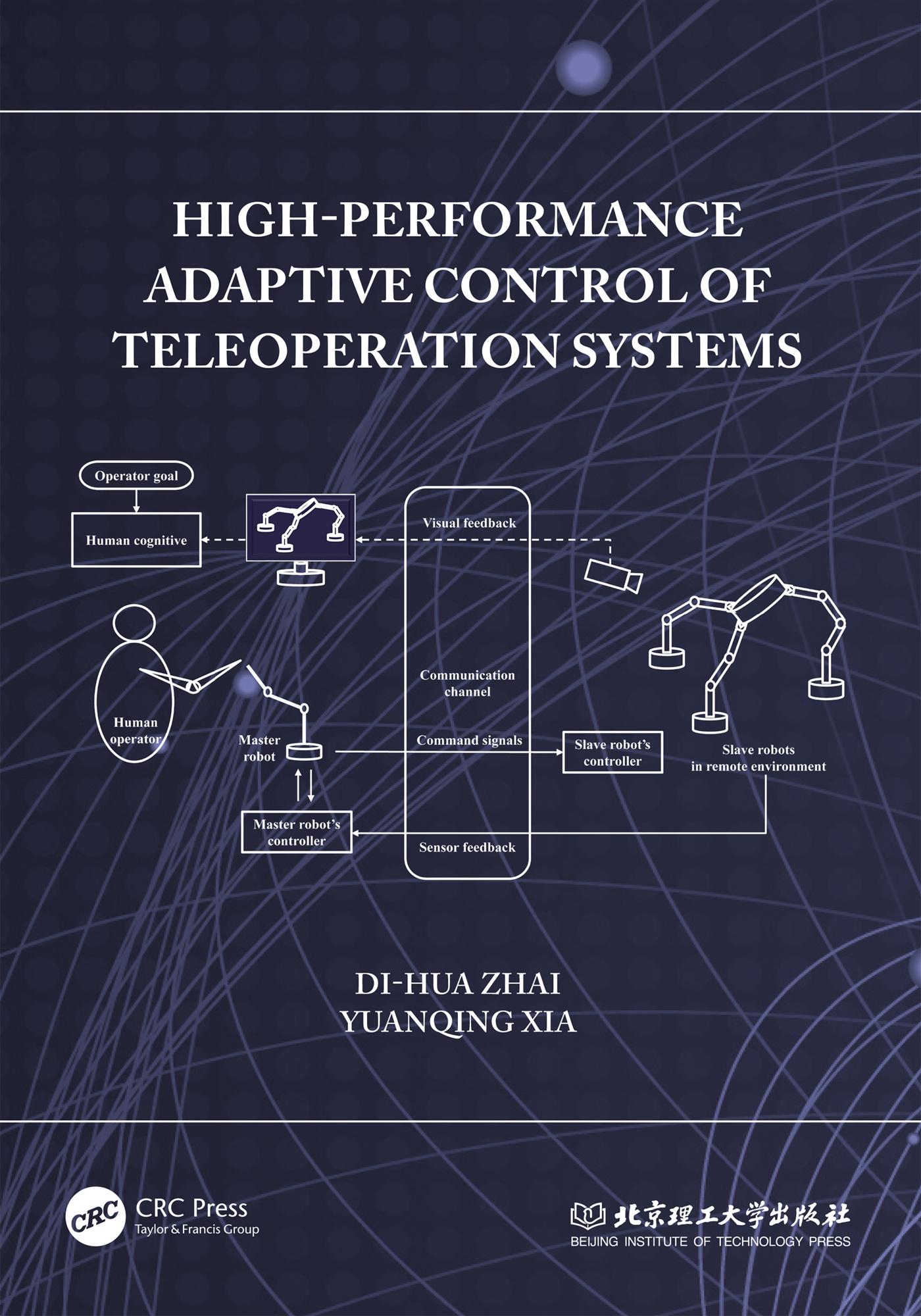
Within a unified switched-control framework, this book investigates the high-performance control designs and theoretic analyses for teleoperation systems, including the joint space and task space teleoperations, the homogeneous and heterogeneous teleoperations, and the single-master single-slave and multi-master multi-slave teleoperations.
The book begins with an introduction to the concepts and challenges of networked teleoperation systems. Then, it investigates a new adaptive control framework based on auxiliary switched filters for the bilateral teleoperation systems to handle the model uncertainty and non-passive external forces. To overcome the input constraints of robotic systems, this adaptive method is also extended to the anti-windup adaptive control case. Furthermore, to apply to multi-robot remote collaboration scenarios and heterogeneous teleoperations, two tele-coordination methods and an adaptive semi-autonomous control method are respectively developed. Finally, the authors examine two finite-time control schemes and two types of improved prescribed performance controls for teleoperation systems to improve the transient-state and steady-state synchronization performances.
This title will be an essential reference for researchers and engineers interested in teleoperation, robotic systems, and nonlinear control systems. It would also prove useful to graduate students in the fields of science, engineering, and computer science.
Betal enkelt med kort, Klarna, Apple Pay eller Google Pay. Ikke fornøyd? Du har alltid 14 dagers angrerett. Les mer i våre vilkår. Har du spørsmål, send oss en e-post på hello@memmo.org.
Memmo gjør det enklere å studere – uansett hvor du er i verden. Hos oss samler du pensumbøker og smarte studieverktøy på ett og samme sted: sammendrag, quizer, podkaster og flashcards. Og så Ted, din studiekompis som svarer på alt du lurer på. Over 50 000 studenter studerer allerede her – bygget for at du skal lære raskere og stresse mindre.