
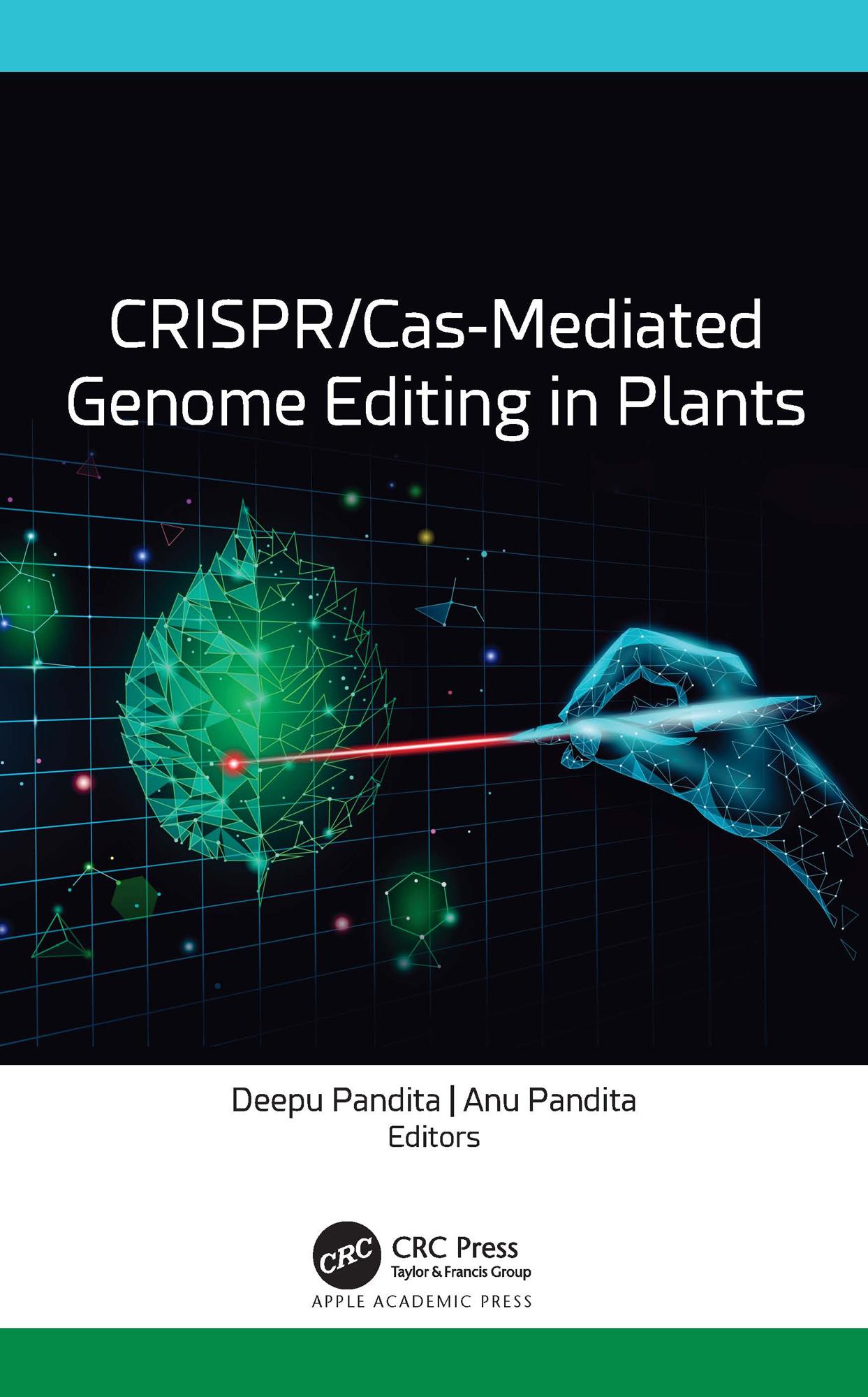
With over 820 million people facing hunger in today’s world, the need of the hour is the design of plant varieties with high yield, improved traits, and resistance properties in order to mitigate the detrimental impacts of biotic and abiotic stress conditions on food crops. This volume highlights the use of Clustered Regularly Interspaced Short Palindromic Repeats (CRISPR) and CRISPR-associated nuclease proteins as a solution for sustainable agriculture. CRISPR/Cas-mediated genome editing (GE) provides a robust, simple, precise, efficient, economical, and revolutionary toolbox that leads to improved plant traits with enhanced yield, quality, and resistance against various stresses, including climate-related stress, insect pests and diseases, pollution-related stresses, etc.
Key features of the book:
- Explains the differences between conventional breeding, genetically modified crops, and genome editing approaches using CRISPR/Cas
- Introduces the tools of genome editing, such as ZFNS (zinc finger nucleases), mega nucleases, and TLENS (transcription activator-like effector nucleases)
- Covers the history, origin, discovery, structure, and classification of CRISPR/Cas
- Examines the databases and computational approaches of CRISPR/Cas
- Highlights genome editing of important crop plants with CRISPR/Cas systems, including wheat, maize. tomato, Brassica crops, rice, fruits
- Explores potential applications of CRISPR/Cas systems for climate smart crops
Betal enkelt med kort, Klarna, Apple Pay eller Google Pay. Ikke fornøyd? Du har alltid 14 dagers angrerett. Les mer i våre vilkår. Har du spørsmål, send oss en e-post på hello@memmo.org.
Memmo gjør det enklere å studere – uansett hvor du er i verden. Hos oss samler du pensumbøker og smarte studieverktøy på ett og samme sted: sammendrag, quizer, podkaster og flashcards. Og så Ted, din studiekompis som svarer på alt du lurer på. Over 50 000 studenter studerer allerede her – bygget for at du skal lære raskere og stresse mindre.