
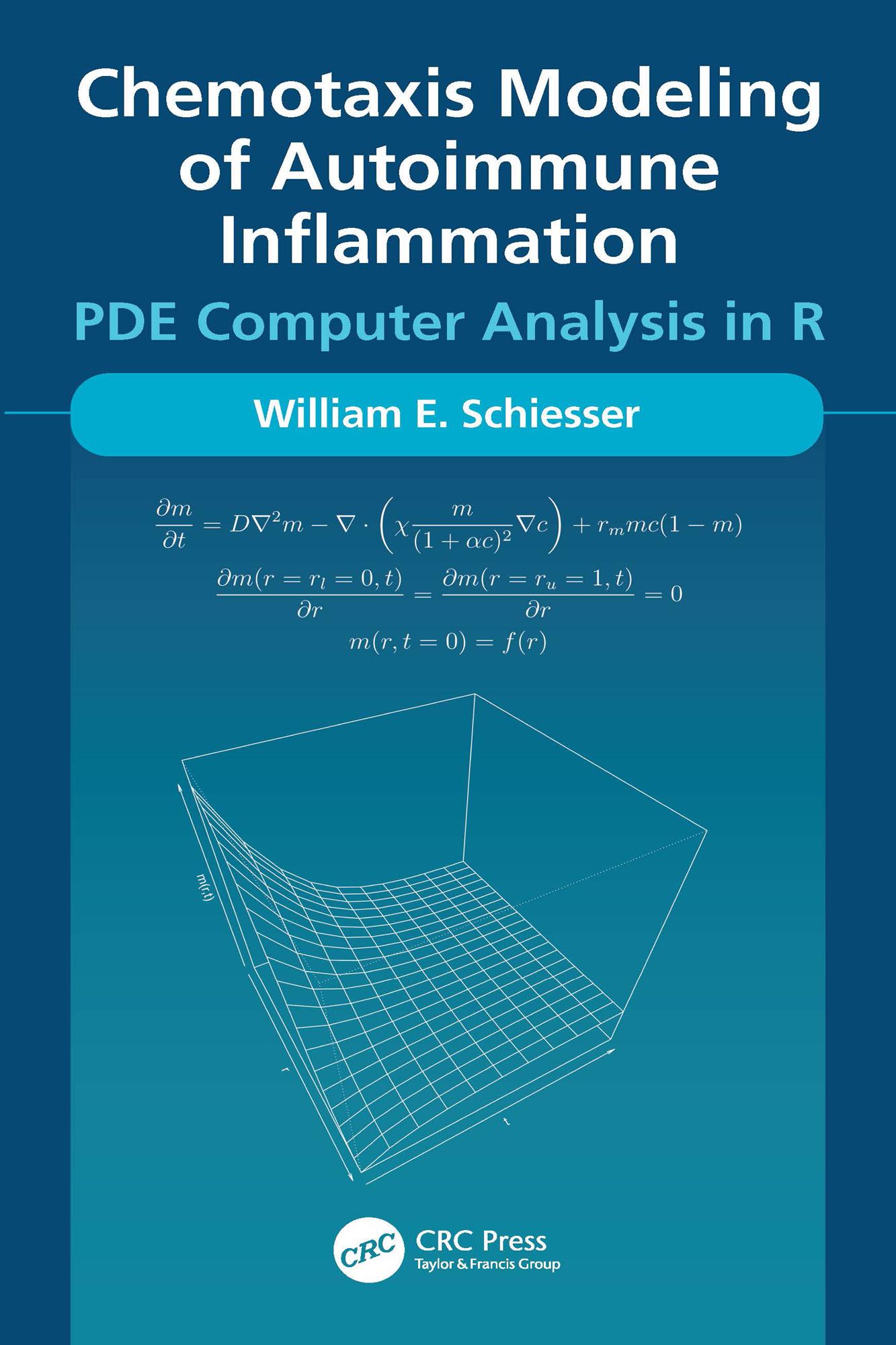
In response to an infection (e.g., from pathogens such as bacteria and viruses), the immune system can deplete macrophages (specialized white blood cells) and produce cytokines that are pro-inflammatory or anti-inflammatory. This counterproductive autoimmune response is represented mathematically as nonlinear chemotaxis diffusion.
This book is directed to the computer-based modeling of chemotaxis inflammation. The spatiotemporal analysis is
based on a model of three partial differential equations (PDEs).
The three PDE model is coded (programmed) as a set of routines in R, a quality, open-source, scientific programming system. The numerical integration (solution) of the PDEs is by the method of lines (MOL).
The three PDE model can be used for computer-based experimentation, for example, parameter variation and changes in the model equations or alternate models, to enhance a quantitative understanding of a postulated
inflammation.
This experimentation is illustrated by chapters pertaining to: (1) the computation and display of the PDE time derivatives, (2) the RHS terms of the PDEs with emphasis on the chemotaxis terms, (3) parameter variations to demonstrate parameter effects and sensitivities and (4) additonal terms in the PDEs to include PDE coupling and extensions of the basic PDE model.
Betal enkelt med kort, Klarna, Apple Pay eller Google Pay. Ikke fornøyd? Du har alltid 14 dagers angrerett. Les mer i våre vilkår. Har du spørsmål, send oss en e-post på hello@memmo.org.
Memmo gjør det enklere å studere – uansett hvor du er i verden. Hos oss samler du pensumbøker og smarte studieverktøy på ett og samme sted: sammendrag, quizer, podkaster og flashcards. Og så Ted, din studiekompis som svarer på alt du lurer på. Over 50 000 studenter studerer allerede her – bygget for at du skal lære raskere og stresse mindre.