
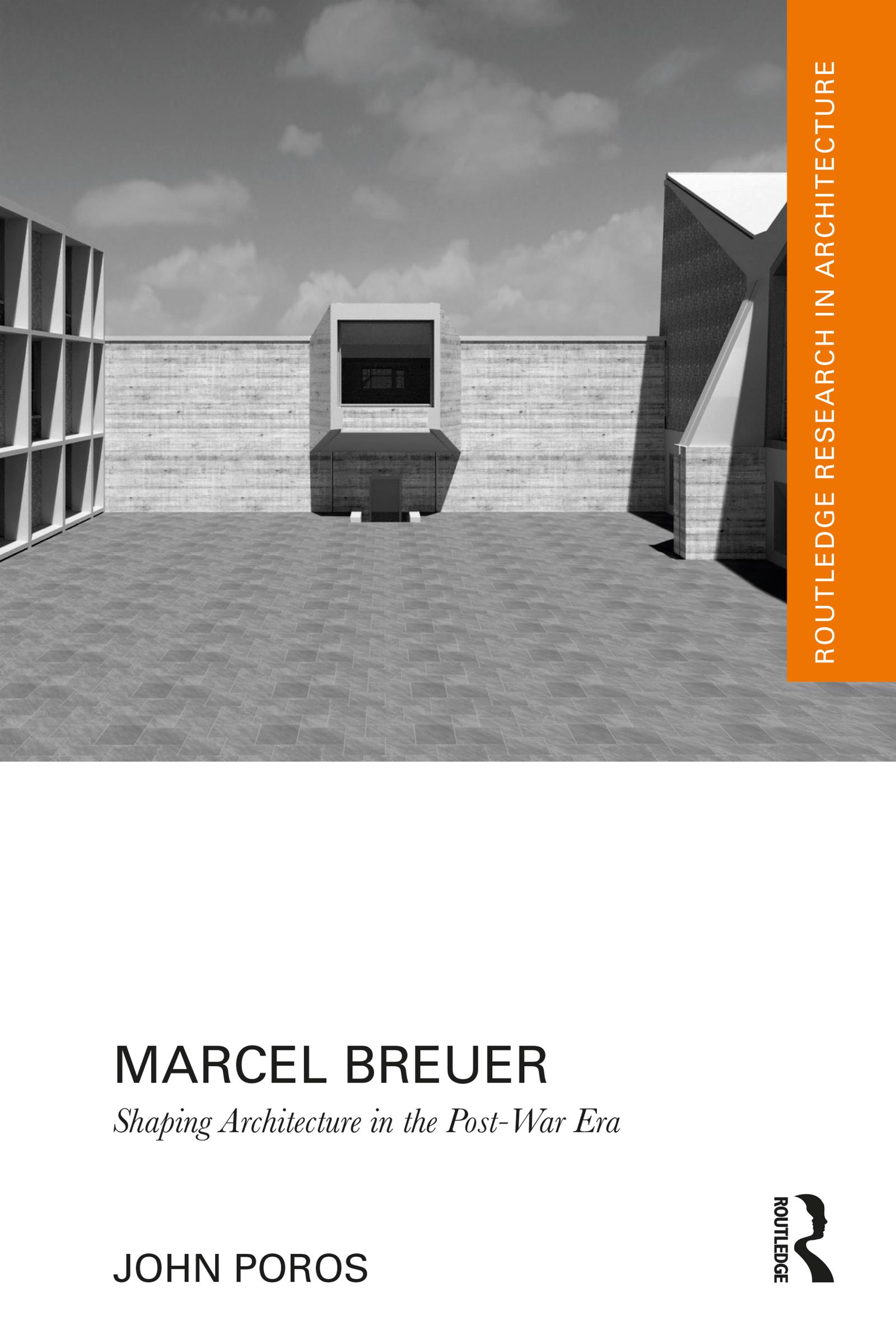
This book tracks the development of Marcel Breuer’s aesthetic clash between uniformity and singularity through the detailed examination of his seminal buildings. Each chapter examines a specific building and puts into context Breuer’s other work and the contemporary movements/architects of the post-war era such as Surrealism, Brutalism and structural expressionism. The buildings examined include the UNESCO Headquarters in Paris, France, of 1958; the IBM Research Center in Le Gaude, France, of 1962; the Annunciation Priory in Bismark, North Dakota, of 1963; and the Atlanta Central Library of 1980.
Marcel Breuer’s approach to design was inspired by the Spanish phrase, sol y sombra (sun and shadow). Sun and shadow meant for Breuer that a juxtaposition of contrasts was necessary; light glass walls and heavy concrete, masses lifted over voids, and serial precast construction resting on sculptural columns became hallmarks of Breuer’s buildings. By creating an architecture of juxtaposition, Breuer’s work can be interpreted as a surrealist recontre, as fueling a new architectural condition.
A critical evaluation of Marcel Breuer’s work, this book is written for graduate students, researchers, and academics interested in his work and how it shaped the architecture of the post-war era.
Betal enkelt med kort, Klarna, Apple Pay eller Google Pay. Ikke fornøyd? Du har alltid 14 dagers angrerett. Les mer i våre vilkår. Har du spørsmål, send oss en e-post på hello@memmo.org.
Memmo gjør det enklere å studere – uansett hvor du er i verden. Hos oss samler du pensumbøker og smarte studieverktøy på ett og samme sted: sammendrag, quizer, podkaster og flashcards. Og så Ted, din studiekompis som svarer på alt du lurer på. Over 50 000 studenter studerer allerede her – bygget for at du skal lære raskere og stresse mindre.