
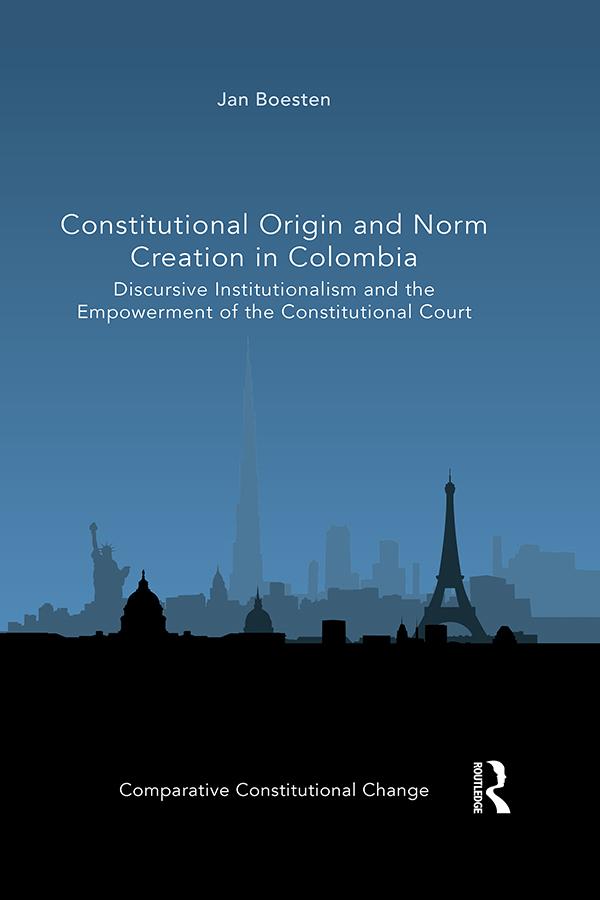
This book explains the growing empowerment of the Colombian Constitutional Court in the early years of the 21st century and develops the concept of the deliberative judge.
Taking the case of the Colombian Constitutional Court and drawing on neoinstitutional theory to explain the relationship between political crisis and institutional reforms, the book challenges the notion of rational choice institutionalism that agents act strategically. It indicates the limits of path dependence and argues instead that discursive institutionalism is the most appropriate method for analyzing processes of institutional learning. Combining theoretical and empirical research, it builds the argument that judicial independence promotes the case for deliberative democracy over rational choice or strategic action approaches. Finally, the book suggests that by introducing communicative and cognitive variables in our understanding of key actors and processes, we are more capable of bridging institutional origin and legacy.
The work will be a valuable resource for academics, researchers, and policy-makers in Constitutional Law, Constitutional Politics, and Constitutional History.
Betal enkelt med kort, Klarna, Apple Pay eller Google Pay. Ikke fornøyd? Du har alltid 14 dagers angrerett. Les mer i våre vilkår. Har du spørsmål, send oss en e-post på hello@memmo.org.
Memmo gjør det enklere å studere – uansett hvor du er i verden. Hos oss samler du pensumbøker og smarte studieverktøy på ett og samme sted: sammendrag, quizer, podkaster og flashcards. Og så Ted, din studiekompis som svarer på alt du lurer på. Over 50 000 studenter studerer allerede her – bygget for at du skal lære raskere og stresse mindre.