
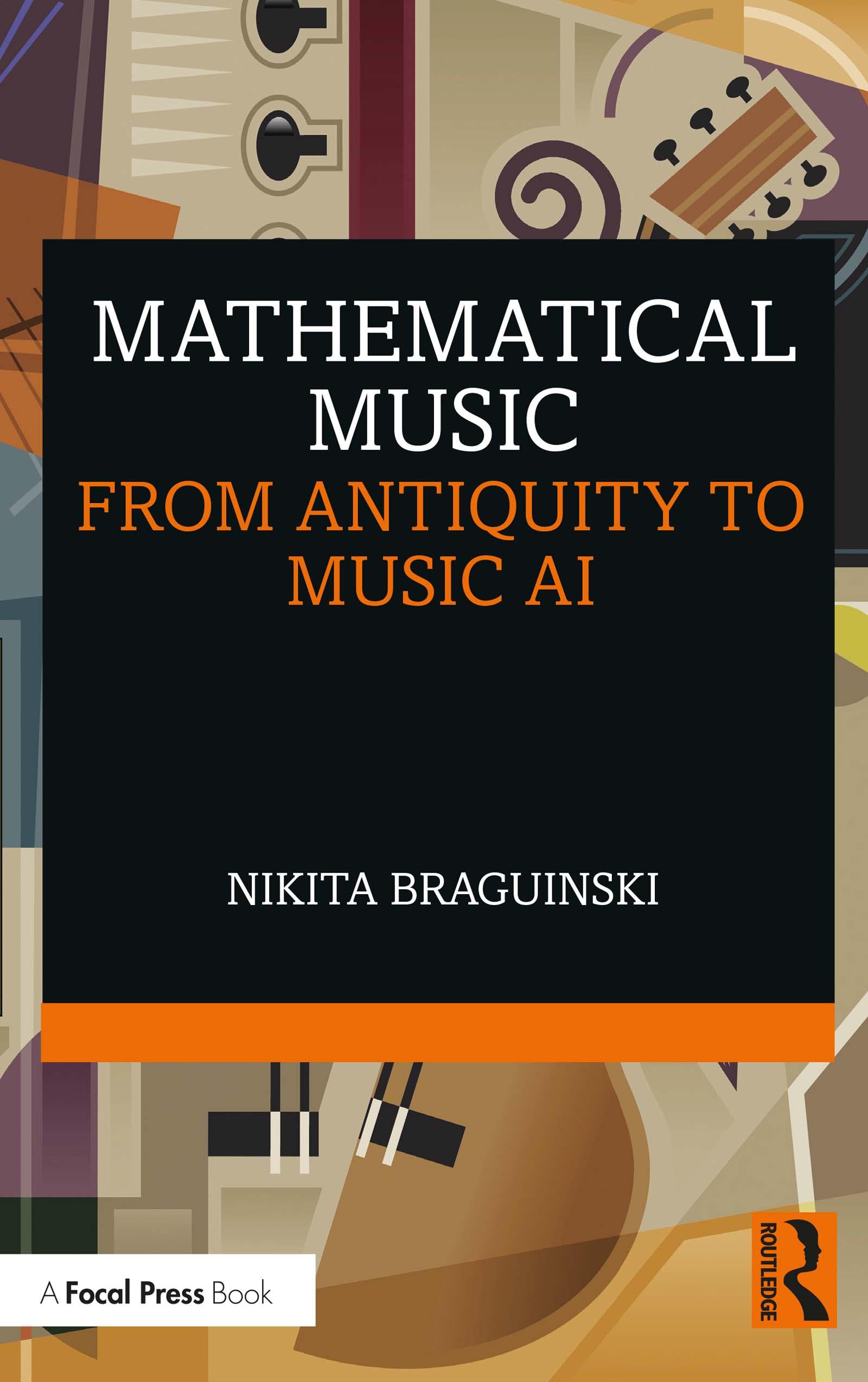
Mathematical Music offers a concise and easily accessible history of how mathematics was used to create music. The story presented in this short, engaging volume ranges from ratios in antiquity to random combinations in the 17th century, 20th-century statistics, and contemporary artificial intelligence.
This book provides a fascinating panorama of the gradual mechanization of thought processes involved in the creation of music. How did Baroque authors envision a composition system based on combinatorics? What was it like to create musical algorithms at the beginning of the 20th century, before the computer became a reality? And how does this all explain today’s use of artificial intelligence and machine learning in music? In addition to discussing the history and the present state of mathematical music, Braguinski also takes a look at what possibilities the near future of music AI might hold for listeners, musicians, and the society.
Grounded in research findings from musicology and the history of technology, and written for the non-specialist general audience, this book helps both student and professional readers to make sense of today’s music AI by situating it in a continuous historical context.
Betal enkelt med kort, Klarna, Apple Pay eller Google Pay. Ikke fornøyd? Du har alltid 14 dagers angrerett. Les mer i våre vilkår. Har du spørsmål, send oss en e-post på hello@memmo.org.
Memmo gjør det enklere å studere – uansett hvor du er i verden. Hos oss samler du pensumbøker og smarte studieverktøy på ett og samme sted: sammendrag, quizer, podkaster og flashcards. Og så Ted, din studiekompis som svarer på alt du lurer på. Over 50 000 studenter studerer allerede her – bygget for at du skal lære raskere og stresse mindre.