
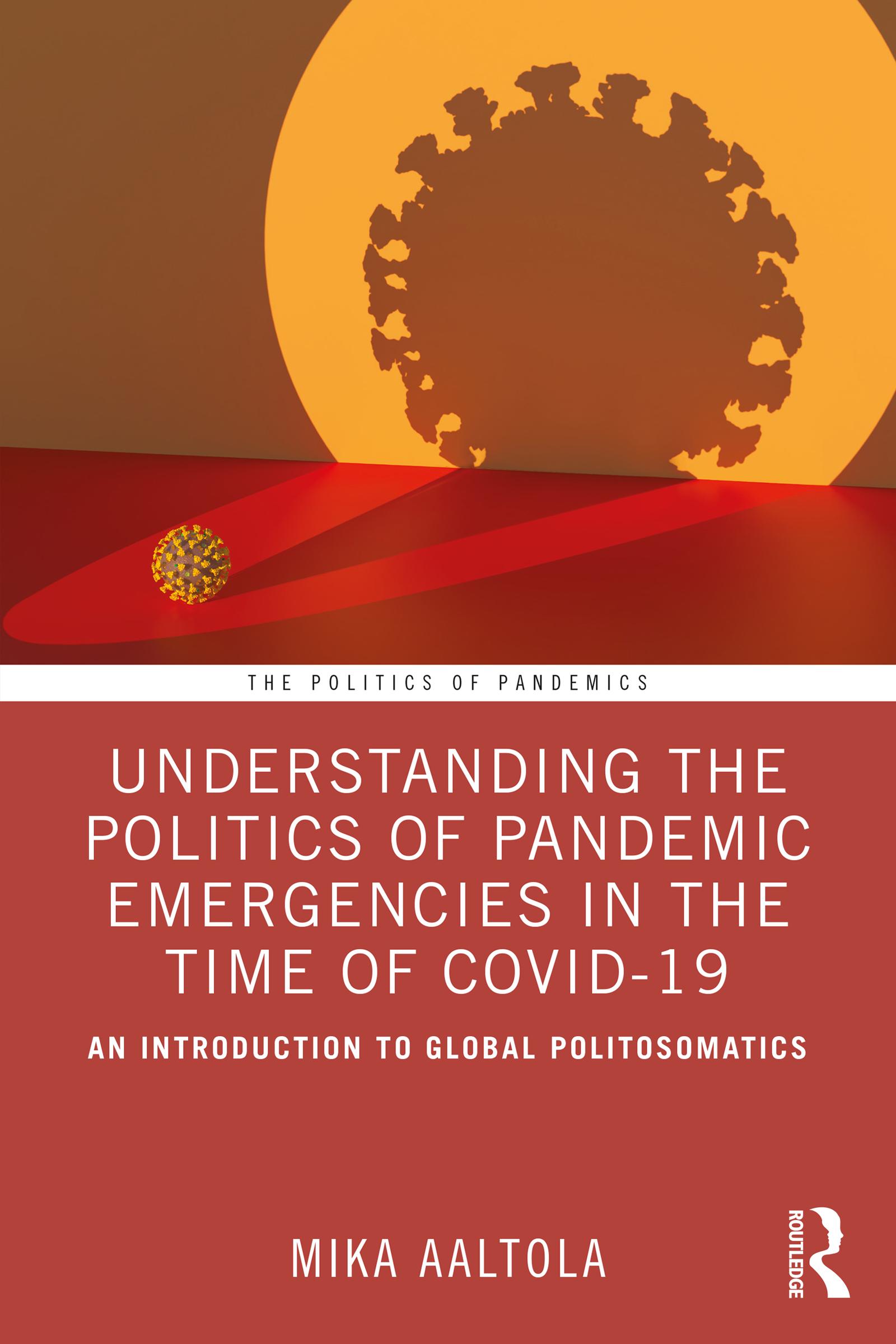
This book reviews the political significance of COVID-19 in the context of earlier pandemic encounters and scares to understand the ways in which it challenges the existing individual health, domestic order, international health governance actors, and, more fundamentally, the circulation-based modus operandi of the present world order.
It argues that contagious diseases should be regarded as complex open-ended phenomena with various features and are not reducible merely to biology and epidemiology. They are, as such, fundamentally politosomatic, namely that they disrupt, agitate, and trigger large-scale processes because individual somatic-level anxieties stem from individuals’ sensing immediate danger through the networks of their local and global connectedness. The author further argues that pandemics have somatic effects in political expressions that transform the epidemic into national security dramas which should not, for the sake of efficient health governance, be treated as aspects extraneous to the disease itself. The book highlights that when a serious infectious disease spreads, a 'threat' is very often externalized into a culturally meaningful 'foreign' entity. Pandemics tend to be territorialized, nationalized, ethnicized, and racialized.
This book will be of key interest to scholars and students of global health and governance, pandemic security, epidemics, history of medicine, geopolitics, international relations, and general readers interested in the COVID-19 pandemic.
Betal enkelt med kort, Klarna, Apple Pay eller Google Pay. Ikke fornøyd? Du har alltid 14 dagers angrerett. Les mer i våre vilkår. Har du spørsmål, send oss en e-post på hello@memmo.org.
Memmo gjør det enklere å studere – uansett hvor du er i verden. Hos oss samler du pensumbøker og smarte studieverktøy på ett og samme sted: sammendrag, quizer, podkaster og flashcards. Og så Ted, din studiekompis som svarer på alt du lurer på. Over 50 000 studenter studerer allerede her – bygget for at du skal lære raskere og stresse mindre.