
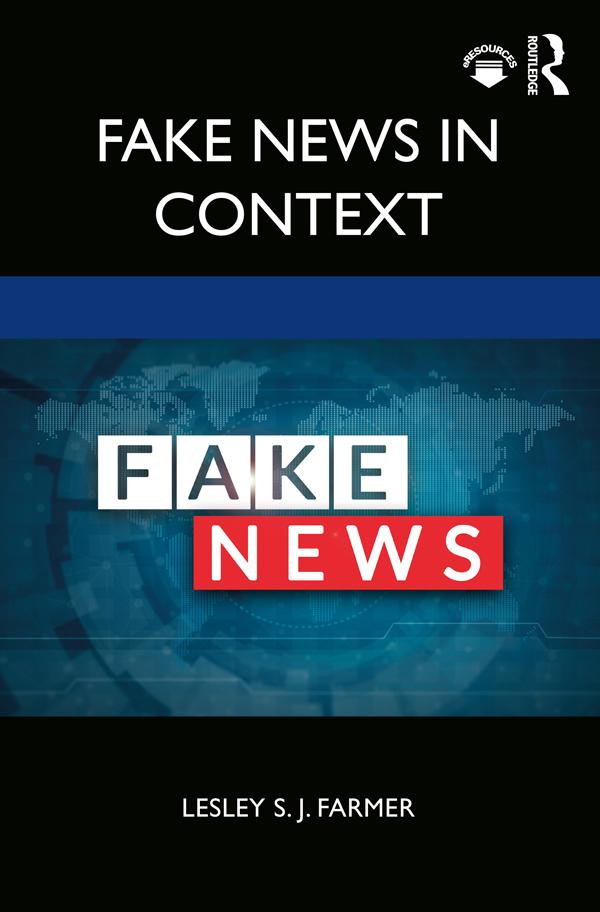
Fake News in Context defines fake news and sets it within a historical and international context. Helping readers to become more skilled at detecting misinformation, the book also demonstrates how such knowledge can be leveraged to facilitate more effective engagement in civic education.
Distinguishing between fake news and other forms of misinformation, the book explains the complete communication cycle of fake news: how and why it is created, disseminated and accessed. The book then explains the physical and psychological reasons why people believe fake news. Providing generic methods for identifying fake news, Farmer also explains the use of fact- checking tools and automated algorithms. The book then details how various literacies, including news, media, visual, information, digital and data, offer unique concepts and skills that can help interpret fake news. Arguing that individuals and groups can respond and counter fake news, which leads to civic engagement and digital citizenship, the book concludes by providing strategies for instruction and tips for collaborating with librarians.
Including a range of international examples, Fake News in Context will be of interest to teaching faculty, and students of library and information science, communication studies, media studies, politics and journalism. Librarians and information professionals will also find a valuable resource in this book.
Betal enkelt med kort, Klarna, Apple Pay eller Google Pay. Ikke fornøyd? Du har alltid 14 dagers angrerett. Les mer i våre vilkår. Har du spørsmål, send oss en e-post på hello@memmo.org.
Memmo gjør det enklere å studere – uansett hvor du er i verden. Hos oss samler du pensumbøker og smarte studieverktøy på ett og samme sted: sammendrag, quizer, podkaster og flashcards. Og så Ted, din studiekompis som svarer på alt du lurer på. Over 50 000 studenter studerer allerede her – bygget for at du skal lære raskere og stresse mindre.