
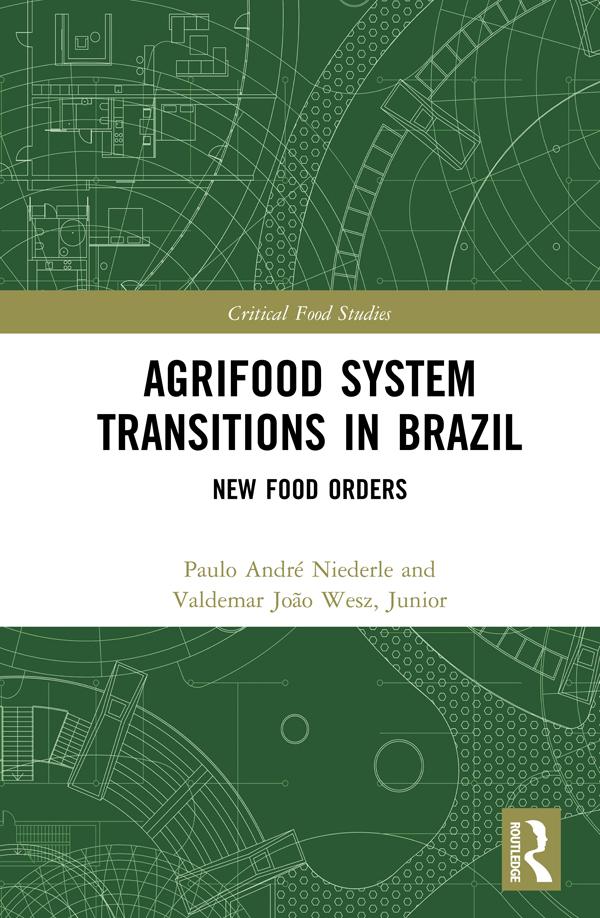
This book explores the agrifood system transitions in Brazil to provide a new understanding of the trajectory of agriculture and rural development in this country. It accentuates the increasing diversifi cation and hybridization of food production and consumption practices throughout history.
With a framework that combines convention theory, neoinstitutional approaches and practice theory, this book suggests the concept of “food orders” which represents different arrangements of practices, institutions and sociotechnical artifacts. By exploring the interrelations between these elements, the book looks at six different food orders: industrial, commercial, domestic, aesthetic, civic and fi nancial, in tandem with examples of practices, sectors and territories to understand the dynamics of each one. This aids in understanding the main tendencies of the agrifood sector in such a vast country that, being a major player in global food markets, also affect production and consumption dynamics in several other countries. Besides, this book also seeks to comprehend the current institutional changes in Brazil that may be critical to interpret the global dissemination of populist and autocratic governments.
Offering key insights into the contemporary sociology of agriculture and food, this book demonstrates how strengthening democracy and supporting the organization of civil society are major challenges when we think about transition for sustainable food systems.
Betal enkelt med kort, Klarna, Apple Pay eller Google Pay. Ikke fornøyd? Du har alltid 14 dagers angrerett. Les mer i våre vilkår. Har du spørsmål, send oss en e-post på hello@memmo.org.
Memmo gjør det enklere å studere – uansett hvor du er i verden. Hos oss samler du pensumbøker og smarte studieverktøy på ett og samme sted: sammendrag, quizer, podkaster og flashcards. Og så Ted, din studiekompis som svarer på alt du lurer på. Over 50 000 studenter studerer allerede her – bygget for at du skal lære raskere og stresse mindre.