
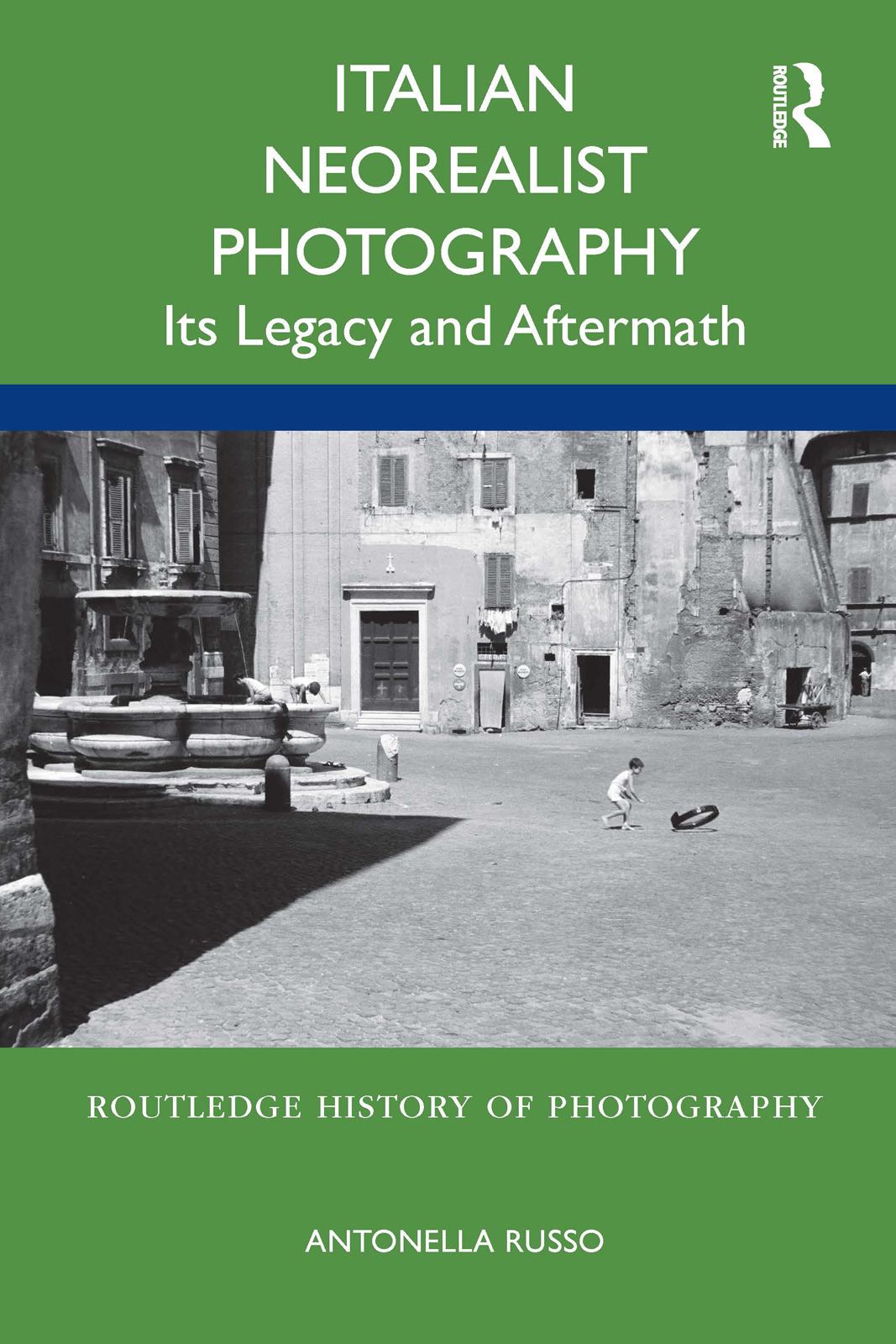
This book offers an analysis of the socio-historical conditions of the rise of postwar Italian photography, considers its practices, and outlines its destiny.
Antonella Russo provides an incisive examination of Neorealist photography, delineates its periodization, traces its instances and its progressive popularization and subsequent co-optation that occurred with the advent of the industrialization of photographic magazines. This volume examines the ethno(photo)graphic missions of Ernesto De Martino in the deep South of Italy, the key role played by the Neorealist writer and painter Carlo Levi as "ambassador of international photography", and the journeys of David Seymour, Henry Cartier Bresson, and Paul Strand in Neorealist Italy. The text includes an account the formation and proliferation of Italian photographic associations and their role in institutionalizing and promoting Italian photography, their link to British and other European photographic societies, and the subsequent decline of Neorealism. It also considers the inception of non-objective photography that thrived soon after the war, in concurrence with the circulation of Neorealism, thus debunking the myth identifying all Italian postwar photography with the Neorealist image.
This book will be particularly useful for scholars and students in the history and theory of photography, and Italian history.
Betal enkelt med kort, Klarna, Apple Pay eller Google Pay. Ikke fornøyd? Du har alltid 14 dagers angrerett. Les mer i våre vilkår. Har du spørsmål, send oss en e-post på hello@memmo.org.
Memmo gjør det enklere å studere – uansett hvor du er i verden. Hos oss samler du pensumbøker og smarte studieverktøy på ett og samme sted: sammendrag, quizer, podkaster og flashcards. Og så Ted, din studiekompis som svarer på alt du lurer på. Over 50 000 studenter studerer allerede her – bygget for at du skal lære raskere og stresse mindre.