
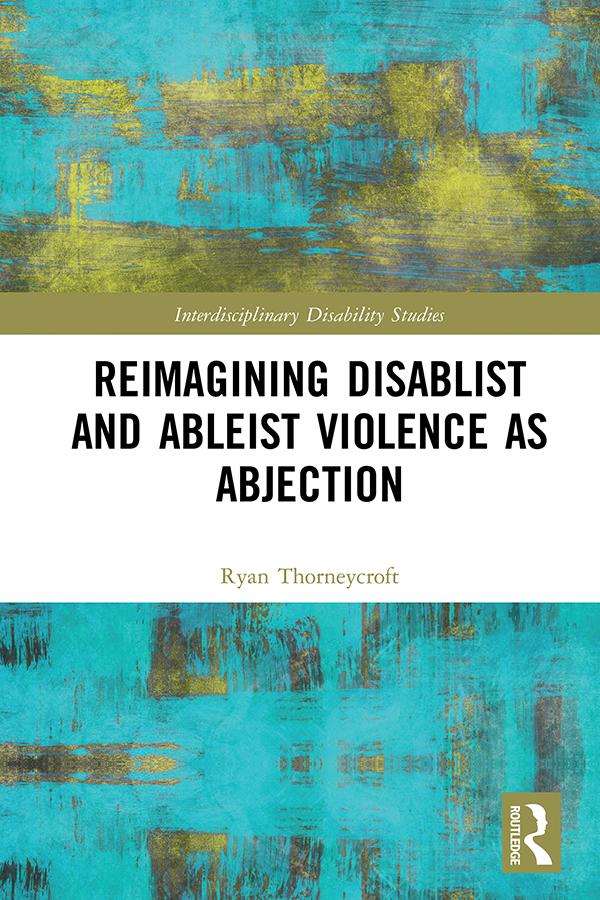
Drawing upon vivid and harrowing life history narratives of people labelled intellectually disabled, this book examines the ways in which disabled subjects are constituted, regulated, governed, and violated through an account of abjection.
Extending interdisciplinary dialogues and approaches, it abandons a construct of violence (which by law requires a stable notion of a victim and a perpetrator) and moves to a theorisation of abjection to explore the ways in which disabled subjects are (re)produced, constituted, and treated through time. Deploying a wide range of interdisciplinary approaches, this book sits at the intersections of criminology and sociology, re-thinks notions of dis/ability, violence, and subjectivity, and utilises crip and queer theory to imagine dis/ability differently.
It will be of interest to all scholars and students of disability studies, sociology and criminology, and specifically those working the areas of life history work, post-structuralism, hate crime, and post-modern criminology.
Betal enkelt med kort, Klarna, Apple Pay eller Google Pay. Ikke fornøyd? Du har alltid 14 dagers angrerett. Les mer i våre vilkår. Har du spørsmål, send oss en e-post på hello@memmo.org.
Memmo gjør det enklere å studere – uansett hvor du er i verden. Hos oss samler du pensumbøker og smarte studieverktøy på ett og samme sted: sammendrag, quizer, podkaster og flashcards. Og så Ted, din studiekompis som svarer på alt du lurer på. Over 50 000 studenter studerer allerede her – bygget for at du skal lære raskere og stresse mindre.