
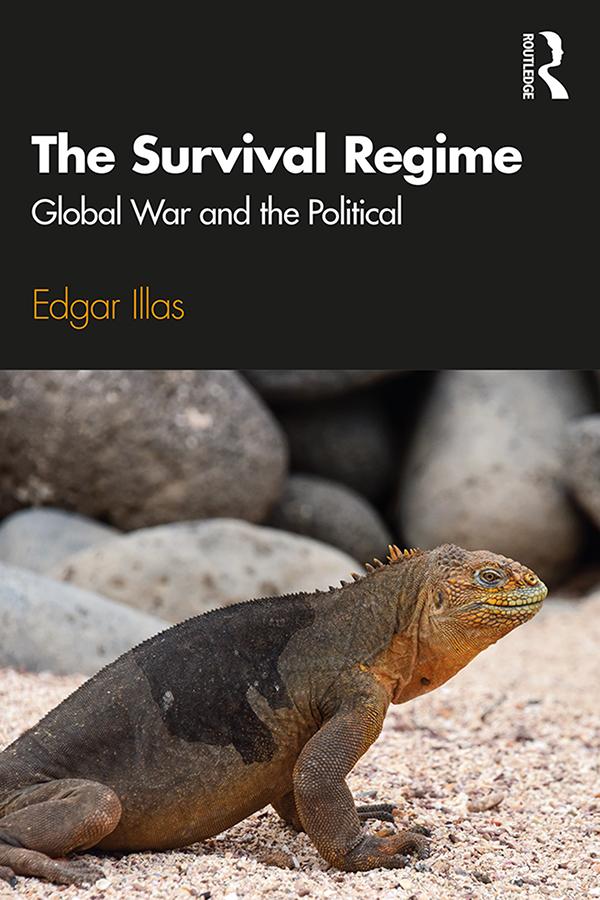
The Survival Regime explores the concept of survival to describe the effects on politics of the fusion of war and capital in globalization. Survival defines a sort of degree zero governmentality that has resulted from the crumbling of the political and spatial architecture of modernity, particularly the state. It does not simply name the new content of all politics or the economic law of the strongest of neoliberalism. Rather, it theorizes how systemic violence and permanent instability force political life to struggle for its own existence, thus generating a regime based on productive engagement and urgent intervention.
Through a critical dialogue with various contemporary thinkers (Galli, Hardt and Negri, Esposito, Agamben, Derrida, and Schmitt, among others), Edgar Illas theorizes survival as a global logic that overcomes the links between life and power explained by the Foucauldian paradigm of biopolitics. He examines parallel notions such as singularity, aleatoriness, eclecticism, and distinction to question previous theorizations of the political based on class struggle, inclusion, hegemony, or recognition of demands.
Through the intersection of different lines of inquiry, including Marxism, war theory, biopolitics, and deconstruction, The Survival Regime contributes to the rethinking of critical theory, political theory, and cultural studies in globalization.
Betal enkelt med kort, Klarna, Apple Pay eller Google Pay. Ikke fornøyd? Du har alltid 14 dagers angrerett. Les mer i våre vilkår. Har du spørsmål, send oss en e-post på hello@memmo.org.
Memmo gjør det enklere å studere – uansett hvor du er i verden. Hos oss samler du pensumbøker og smarte studieverktøy på ett og samme sted: sammendrag, quizer, podkaster og flashcards. Og så Ted, din studiekompis som svarer på alt du lurer på. Over 50 000 studenter studerer allerede her – bygget for at du skal lære raskere og stresse mindre.