
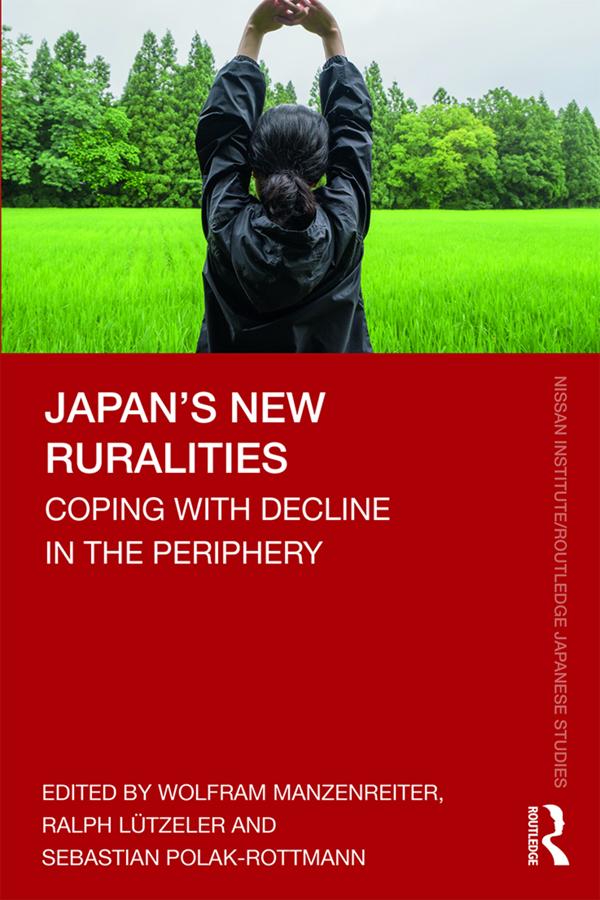
Seeking to challenge negative perceptions within Japanese media and politics on the future of the countryside, the contributors to this book present a counterargument to the inevitable demise of rural society.
Contrary to the dominant argument, which holds outmigration and demographic hyper-aging as primarily responsible for rural decline, this book highlights the spatial dimension of power differences behind uneven development in contemporary Japan. Including many fi eldwork-based case studies, the chapters discuss topics such as corporate farming, local energy systems and public healthcare, examining the constraints and possibilities of rural self-determination under the centripetal impact of forces located both in and outside of the country. Focusing on asymmetries of power to explore regional autonomy and heteronomy, it also examines "peripheralization" and the "global countryside," two recent theoretical contributions to the fi eld, as a common framework.
Japan’s New Ruralities addresses the complexity of rural decline in the context of debates on globalization and power differences. As such, it will be of interest to students and scholars of sociology, anthropology, human geography and politics, as well as Japanese Studies.
Betal enkelt med kort, Klarna, Apple Pay eller Google Pay. Ikke fornøyd? Du har alltid 14 dagers angrerett. Les mer i våre vilkår. Har du spørsmål, send oss en e-post på hello@memmo.org.
Memmo gjør det enklere å studere – uansett hvor du er i verden. Hos oss samler du pensumbøker og smarte studieverktøy på ett og samme sted: sammendrag, quizer, podkaster og flashcards. Og så Ted, din studiekompis som svarer på alt du lurer på. Over 50 000 studenter studerer allerede her – bygget for at du skal lære raskere og stresse mindre.