
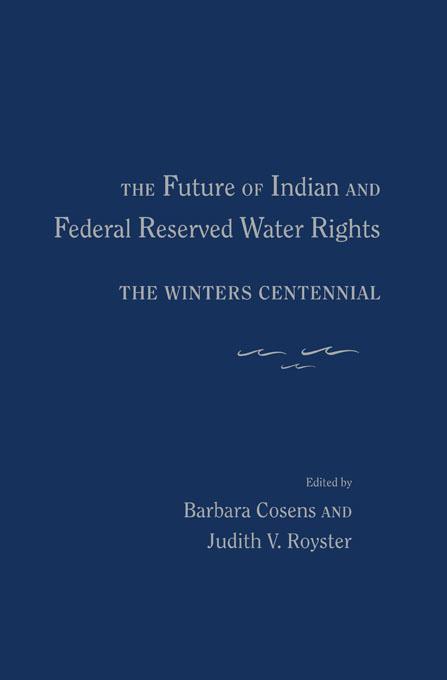
On January 6, 1908, the Supreme Court ruled that when land is set aside for the use of Indian tribes, that reservation of land includes reserved water rights. The Winters Doctrine, as it has come to be known, is now a fundamental principle of both federal Indian law and water law and has expanded beyond Indian reservations to include all federal reservations of land.
<br><br>
Ordinarily, there would not be much to say about a one hundred-year-old Supreme Court case. But while its central conclusion that a claim to water was reserved when the land was reserved for Indians represents a commitment to justice, the exact nature of that commitment-its legal basis, scope, implications for non-Indian water rights holders, the purposes for and quantities of water reserved, the geographic nexus between the land and the water reserved, and many other details of practical consequence-has been, and continues to be, litigated and negotiated. In this detailed collection of essays, lawyers, historians, and tribal leaders explore the nuances of these issues and legacies.
Betal enkelt med kort, Klarna, Apple Pay eller Google Pay. Ikke fornøyd? Du har alltid 14 dagers angrerett. Les mer i våre vilkår. Har du spørsmål, send oss en e-post på hello@memmo.org.
Memmo gjør det enklere å studere – uansett hvor du er i verden. Hos oss samler du pensumbøker og smarte studieverktøy på ett og samme sted: sammendrag, quizer, podkaster og flashcards. Og så Ted, din studiekompis som svarer på alt du lurer på. Over 50 000 studenter studerer allerede her – bygget for at du skal lære raskere og stresse mindre.