
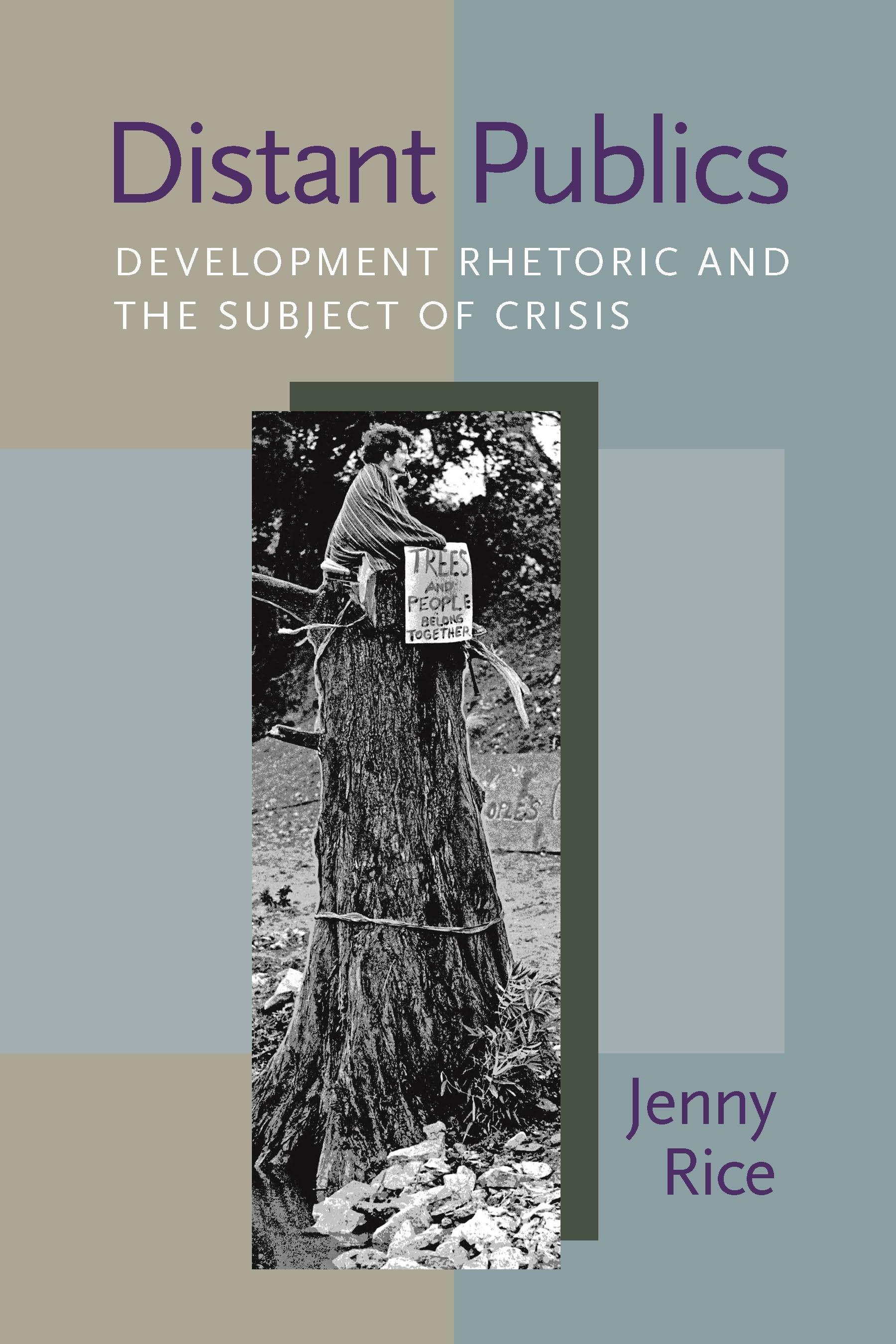
Urban sprawl is omnipresent in America and has left many citizens questioning their ability to stop it. In Distant Publics, Jenny Rice examines patterns of public discourse that have evolved in response to development in urban and suburban environments. Centering her study on Austin, Texas, Rice finds a city that has simultaneously celebrated and despised development.
Rice outlines three distinct ways that the rhetoric of publics counteracts development: through injury claims, memory claims, and equivalence claims. In injury claims, rhetors frame themselves as victims in a dispute. Memory claims allow rhetors to anchor themselves to an older, deliberative space, rather than to a newly evolving one. Equivalence claims see the benefits on both sides of an issue, and here rhetors effectively become nonactors.
Rice provides case studies of development disputes that place the reader in the middle of real-life controversies and evidence her theories of claims-based public rhetorics. She finds that these methods comprise the most common (though not exclusive) vernacular surrounding development and shows how each is often counterproductive to its own goals. Rice further demonstrates that these claims create a particular role or public subjectivity grounded in one's own feelings, which serves to distance publics from each other and the issues at hand.
Rice argues that rhetoricians have a duty to transform current patterns of public development discourse so that all individuals may engage in matters of crisis. She articulates its sustainability as both a goal and future disciplinary challenge of rhetorical studies and offers tools and methodologies toward that end.
Rice outlines three distinct ways that the rhetoric of publics counteracts development: through injury claims, memory claims, and equivalence claims. In injury claims, rhetors frame themselves as victims in a dispute. Memory claims allow rhetors to anchor themselves to an older, deliberative space, rather than to a newly evolving one. Equivalence claims see the benefits on both sides of an issue, and here rhetors effectively become nonactors.
Rice provides case studies of development disputes that place the reader in the middle of real-life controversies and evidence her theories of claims-based public rhetorics. She finds that these methods comprise the most common (though not exclusive) vernacular surrounding development and shows how each is often counterproductive to its own goals. Rice further demonstrates that these claims create a particular role or public subjectivity grounded in one's own feelings, which serves to distance publics from each other and the issues at hand.
Rice argues that rhetoricians have a duty to transform current patterns of public development discourse so that all individuals may engage in matters of crisis. She articulates its sustainability as both a goal and future disciplinary challenge of rhetorical studies and offers tools and methodologies toward that end.
Kategori: Journalistik & kommunikation
e-ISBN: 9780822978015
Betal enkelt med kort, Klarna, Apple Pay eller Google Pay. Ikke fornøyd? Du har alltid 14 dagers angrerett. Les mer i våre vilkår. Har du spørsmål, send oss en e-post på hello@memmo.org.
Memmo gjør det enklere å studere – uansett hvor du er i verden. Hos oss samler du pensumbøker og smarte studieverktøy på ett og samme sted: sammendrag, quizer, podkaster og flashcards. Og så Ted, din studiekompis som svarer på alt du lurer på. Over 50 000 studenter studerer allerede her – bygget for at du skal lære raskere og stresse mindre.
Du vil kanskje også like
Kjøp boken0