
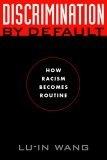
Much as we “select” computer settings by default—reflexively, without thinking, and sometimes without realizing there are other options—we often discriminate by default as well. And just as default computer settings tend to become locked in or entrenched as the standard, discrimination by default creates a situation in which disparate outcomes are expected, accepted, and taken for granted. The killing of Amadou Diallo, racial disparities in medical care, the dominance of Whites and men in certain professions, and even the uneven media attention paid to crimes depending on their victims’ race and class, all might be cases of discrimination by, or as, default.
Wang contends that, today, most discrimination occurs by default and not design, making legal prohibitions that focus on those who discriminate out of ill will inadequate to redress the largest share of modern discrimination. She draws on social psychology to detail three ways in which unconscious assumptions can lead to discrimination, showing how they play out in a range of everyday settings. Wang then demonstrates how these dynamics interact in medical care to produce an invisible, self-fulfilling, and self-perpetuating prophecy of racial disparity. She goes on to suggest ways in which institutions and individuals might recognize, interrupt, and override the discriminatory default.
Betal enkelt med kort, Klarna, Apple Pay eller Google Pay. Ikke fornøyd? Du har alltid 14 dagers angrerett. Les mer i våre vilkår. Har du spørsmål, send oss en e-post på hello@memmo.org.
Memmo gjør det enklere å studere – uansett hvor du er i verden. Hos oss samler du pensumbøker og smarte studieverktøy på ett og samme sted: sammendrag, quizer, podkaster og flashcards. Og så Ted, din studiekompis som svarer på alt du lurer på. Over 50 000 studenter studerer allerede her – bygget for at du skal lære raskere og stresse mindre.