
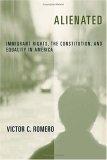
Throughout American history, the government has used U.S. citizenship and immigration law to protect privileged groups from less privileged ones, using citizenship as a “legitimate” proxy for otherwise invidious, and often unconstitutional, discrimination on the basis of race. While racial discrimination is rarely legally acceptable today, profiling on the basis of citizenship is still largely unchecked, and has in fact arguably increased in the wake of the September 11 terror attacks on the United States. In this thoughtful examination of the intersection between American immigration and constitutional law, Victor C. Romero draws our attention to a “constitutional immigration law paradox” that reserves certain rights for U.S. citizens only, while simultaneously purporting to treat all people fairly under constitutional law regardless of citizenship.
As a naturalized Filipino American, Romero brings an outsider's perspective to Alienated, forcing us to look at constitutional immigration law from the vantage point of people whose citizenship status is murky (either legally or from the viewpoint of other citizens and lawmakers), including foreign-born adoptees, undocumented immigrants, tourists, foreign students, and same-gender bi-national partners. Romero endorses an equality-based reading of the Constitution and advocates a new theoretical and practical approach that protects the individual rights of non-citizens without sacrificing their personhood.
Betal enkelt med kort, Klarna, Apple Pay eller Google Pay. Ikke fornøyd? Du har alltid 14 dagers angrerett. Les mer i våre vilkår. Har du spørsmål, send oss en e-post på hello@memmo.org.
Memmo gjør det enklere å studere – uansett hvor du er i verden. Hos oss samler du pensumbøker og smarte studieverktøy på ett og samme sted: sammendrag, quizer, podkaster og flashcards. Og så Ted, din studiekompis som svarer på alt du lurer på. Over 50 000 studenter studerer allerede her – bygget for at du skal lære raskere og stresse mindre.