
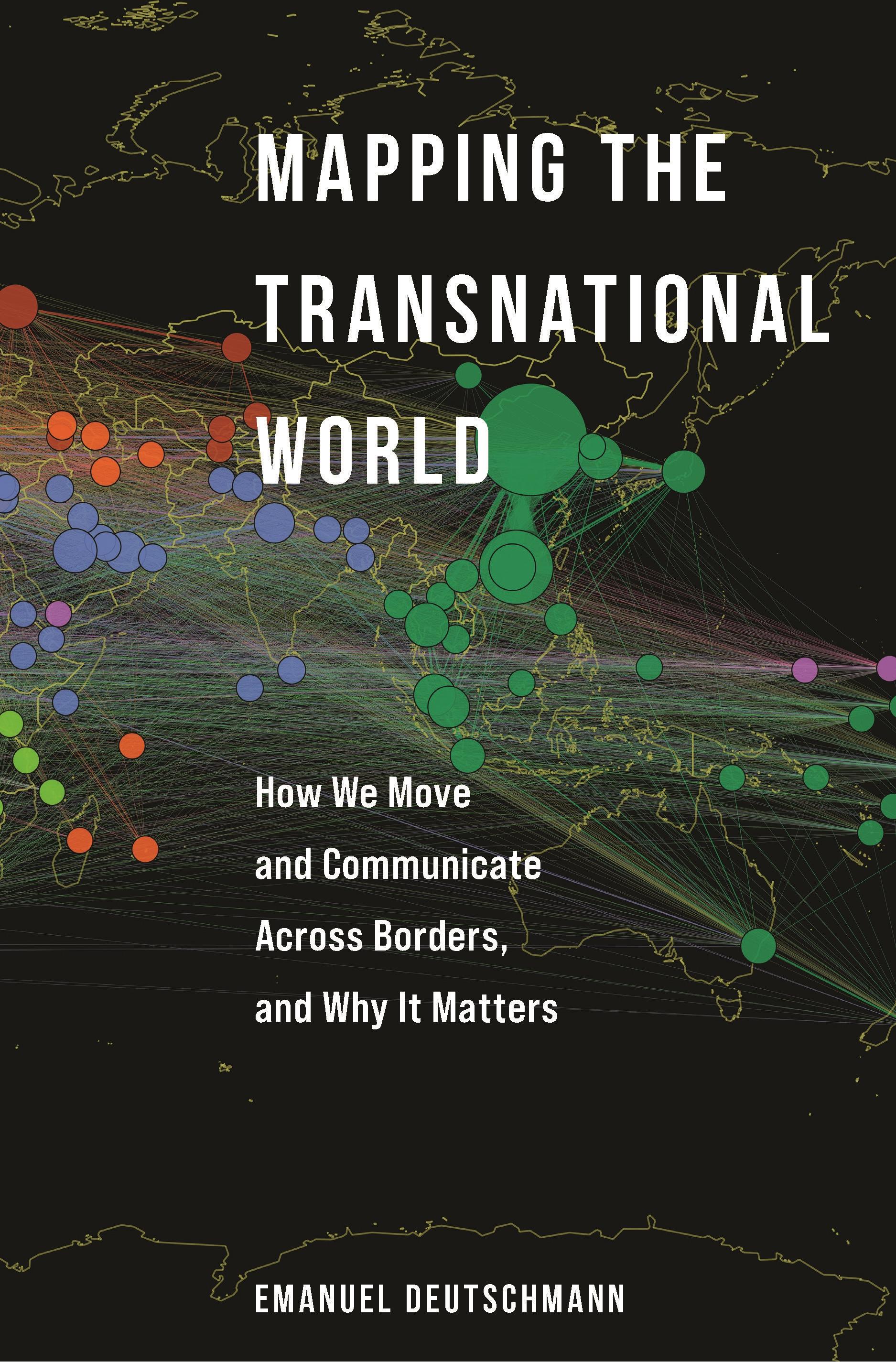
A study of the structure, growth, and future of transnational human travel and communication
Increasingly, people travel and communicate across borders. Yet, we still know little about the overall structure of this transnational world. Is it really a fully globalized world in which everything is linked, as popular catchphrases like “global village” suggest? Through a sweeping comparative analysis of eight types of mobility and communication among countries worldwide—from migration and tourism to Facebook friendships and phone calls—Mapping the Transnational World demonstrates that our behavior is actually regionalized, not globalized.
Emanuel Deutschmann shows that transnational activity within world regions is not so much the outcome of political, cultural, or economic factors, but is driven primarily by geographic distance. He explains that the spatial structure of transnational human activity follows a simple mathematical function, the power law, a pattern that also fits the movements of many other animal species on the planet. Moreover, this pattern remained extremely stable during the five decades studied—1960 to 2010. Unveiling proximity-induced regionalism as a major feature of planet-scale networks of transnational human activity, Deutschmann provides a crucial corrective to several fields of research.
Revealing why a truly global society is unlikely to emerge, Mapping the Transnational World highlights the essential role of interaction beyond borders on a planet that remains spatially fragmented.
Betal enkelt med kort, Klarna, Apple Pay eller Google Pay. Ikke fornøyd? Du har alltid 14 dagers angrerett. Les mer i våre vilkår. Har du spørsmål, send oss en e-post på hello@memmo.org.
Memmo gjør det enklere å studere – uansett hvor du er i verden. Hos oss samler du pensumbøker og smarte studieverktøy på ett og samme sted: sammendrag, quizer, podkaster og flashcards. Og så Ted, din studiekompis som svarer på alt du lurer på. Over 50 000 studenter studerer allerede her – bygget for at du skal lære raskere og stresse mindre.