
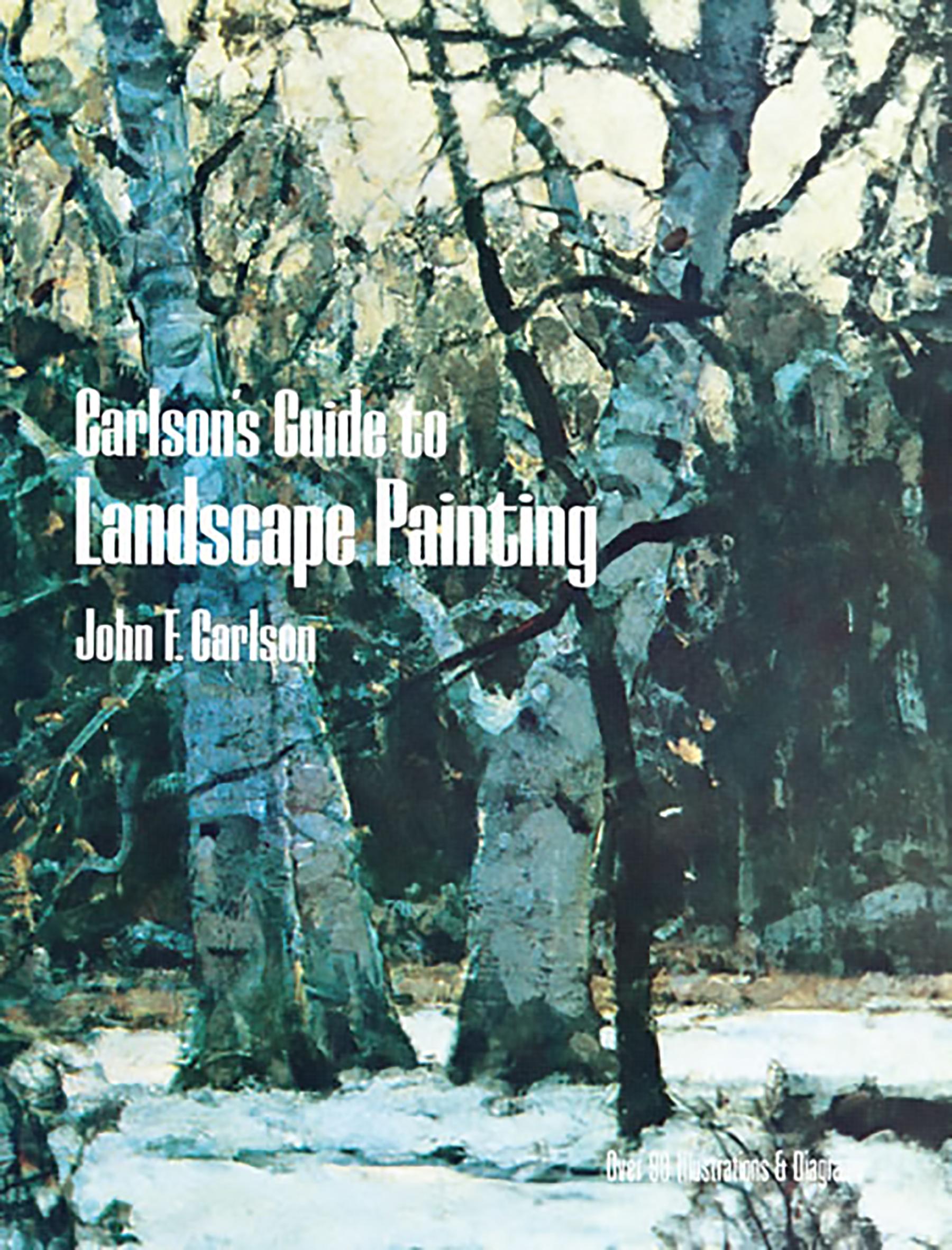
Written by a famous American painter and teacher, whose landscapes are found in many of the world's most noted museums, this book is known as one of the art student's most helpful guides. It provides a wealth of advice on the choice of subject; it tells what to look for and aim for, and explains the mysteries of color, atmospheric conditions, and other phenomena to be found in nature.
Through his profound understanding of the physical nature of landscapes and his highly developed artistic sense, John Carlson is able to explain both the whys and the hows of the various aspects of landscape painting. Among the subjects covered are angles and consequent values (an insightful concept necessary for strong overall unity of design), aerial and linear perspective, the painting of trees, the emotional properties of line and mass in composition, light, unity of tone, choice of subject, and memory work. In the beginning chapters, the author tells how to make the best of canvas, palette, colors, brushes, and other materials and gives valuable advice about texture, glazing, varnishing, bleaching, retouching, and framing. Thirty-four reproductions of Mr. Carlson's own work and 58 of his explanatory diagrams are shown on pages adjoining the text.
As Howard Simon says in the introduction: "Crammed into its pages are the thoughts and experiences of a lifetime of painting and teaching. Undoubtedly it is a good book for the beginner, but the old hand at art will appreciate its honesty and broadness of viewpoint. It confines itself to the mechanics of landscape painting but, philosophically, it roams far and wide. . . . This is a book to keep, to read at leisure, and to look into for the solution of problems as they arise, when the need for an experienced hand is felt."
Through his profound understanding of the physical nature of landscapes and his highly developed artistic sense, John Carlson is able to explain both the whys and the hows of the various aspects of landscape painting. Among the subjects covered are angles and consequent values (an insightful concept necessary for strong overall unity of design), aerial and linear perspective, the painting of trees, the emotional properties of line and mass in composition, light, unity of tone, choice of subject, and memory work. In the beginning chapters, the author tells how to make the best of canvas, palette, colors, brushes, and other materials and gives valuable advice about texture, glazing, varnishing, bleaching, retouching, and framing. Thirty-four reproductions of Mr. Carlson's own work and 58 of his explanatory diagrams are shown on pages adjoining the text.
As Howard Simon says in the introduction: "Crammed into its pages are the thoughts and experiences of a lifetime of painting and teaching. Undoubtedly it is a good book for the beginner, but the old hand at art will appreciate its honesty and broadness of viewpoint. It confines itself to the mechanics of landscape painting but, philosophically, it roams far and wide. . . . This is a book to keep, to read at leisure, and to look into for the solution of problems as they arise, when the need for an experienced hand is felt."
Sider: 144
Kategori: Konst, Design & Fotografi
e-ISBN: 9780486317458
Fraktvekt: 1.2 kg
Sendes innen: 1-2 dager
Betal enkelt med kort, Klarna, Apple Pay eller Google Pay. Ikke fornøyd? Du har alltid 14 dagers angrerett. Les mer i våre vilkår. Har du spørsmål, send oss en e-post på hello@memmo.org.
Memmo gjør det enklere å studere – uansett hvor du er i verden. Hos oss samler du pensumbøker og smarte studieverktøy på ett og samme sted: sammendrag, quizer, podkaster og flashcards. Og så Ted, din studiekompis som svarer på alt du lurer på. Over 50 000 studenter studerer allerede her – bygget for at du skal lære raskere og stresse mindre.
Du vil kanskje også like
Kjøp boken0