
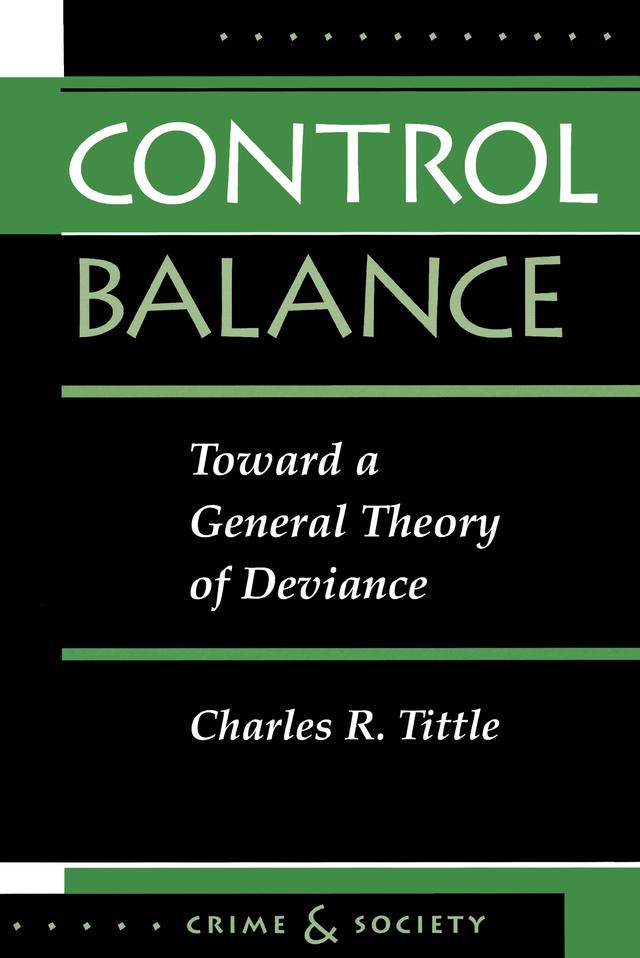
A major contribution to the field of crime/deviance, this volume by noted criminologist Charles R. Tittle puts forth an integrated theory of deviance—control balance. Its central premise is that the total amount of control people are subjected to, relative to the control they can exercise, will affect the probability and type of their deviant behavior. In developing control balance, Tittle critically reviews other general theories such as anomie, Marxian conflict, social control, differential association/social learning, labelling, and routine activities and offers reasons why those theories are insufficient. Using real-world examples to illustrate his argument, he contends that deviance results from the convergence of four variables, each of which represents an interactive nexus of several inputs, including most prominently a control imbalance. The variables are predisposition, motivation, opportunity, and constraint. Control balance theory also explains six basic types of deviance, ranging from predation, defiance, and submissiveness on one end of a control ratio continuum to exploitation, plunder, and decadence on the other. Tittle conceives of control balance as a continuation, or temporary culmination, of the collective efforts of crime/deviance scholars who have gone before, presenting it as a vehicle for trying to achieve a fully adequate general theory of deviance.
Betal enkelt med kort, Klarna, Apple Pay eller Google Pay. Ikke fornøyd? Du har alltid 14 dagers angrerett. Les mer i våre vilkår. Har du spørsmål, send oss en e-post på hello@memmo.org.
Memmo gjør det enklere å studere – uansett hvor du er i verden. Hos oss samler du pensumbøker og smarte studieverktøy på ett og samme sted: sammendrag, quizer, podkaster og flashcards. Og så Ted, din studiekompis som svarer på alt du lurer på. Over 50 000 studenter studerer allerede her – bygget for at du skal lære raskere og stresse mindre.
Du vil kanskje også like
Kjøp boken0