
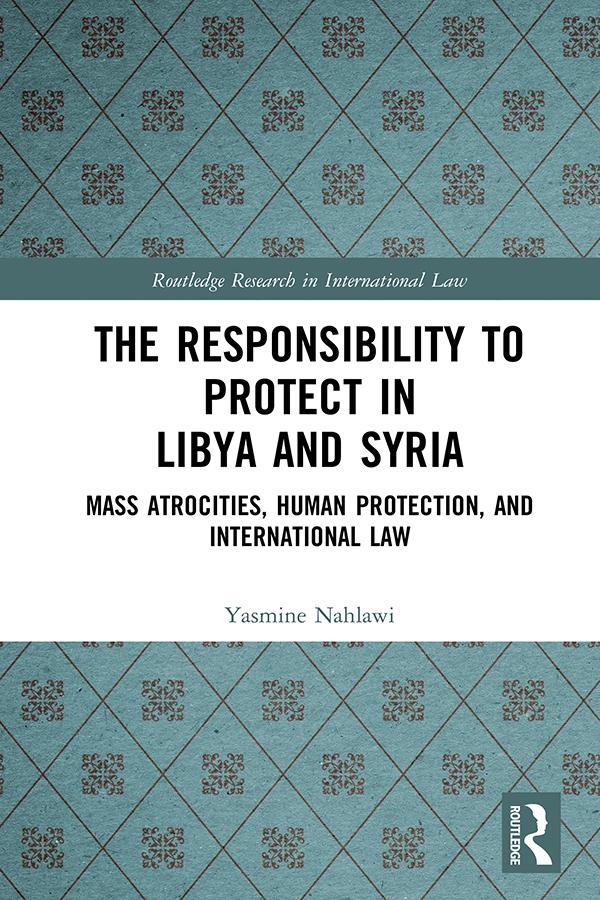
This book offers a novel and contemporary examination of the ‘responsibility to protect’ (R2P) doctrine from an international legal perspective and analyses how the doctrine was applied within the Libyan and Syrian conflicts as two recent and highly significant R2P cases.
The book dissects each of R2P’s three component pillars to examine their international legal underpinnings, drawing upon diverse legal frameworks – including the laws of the UN, laws of international organisations, human rights law, humanitarian law, criminal law, environmental law, and laws of State responsibility – to extract conclusions regarding existing and emerging host and third-State obligations to prevent and react to mass atrocity crimes. It uses this legal grounding to critically examine specific aspects of the Libyan and Syrian R2P cases, engaging with some of the more traditional debates surrounding R2P’s application, most notably those that pertain to the use of force (or lack thereof), but also exploring some of the less-researched non-military methods that were or could have been employed by States and international organisations to uphold the doctrine. Such an analysis captures the diversity in the means and actors through which R2P can be implemented and allows for the extraction of more nuanced conclusions regarding the doctrine’s strengths and limitations, gaps in enforceability, levels of State support, and future trajectory.
The book will be of interest to scholars and students in the field of international law and human rights law.
Betal enkelt med kort, Klarna, Apple Pay eller Google Pay. Ikke fornøyd? Du har alltid 14 dagers angrerett. Les mer i våre vilkår. Har du spørsmål, send oss en e-post på hello@memmo.org.
Memmo gjør det enklere å studere – uansett hvor du er i verden. Hos oss samler du pensumbøker og smarte studieverktøy på ett og samme sted: sammendrag, quizer, podkaster og flashcards. Og så Ted, din studiekompis som svarer på alt du lurer på. Over 50 000 studenter studerer allerede her – bygget for at du skal lære raskere og stresse mindre.