
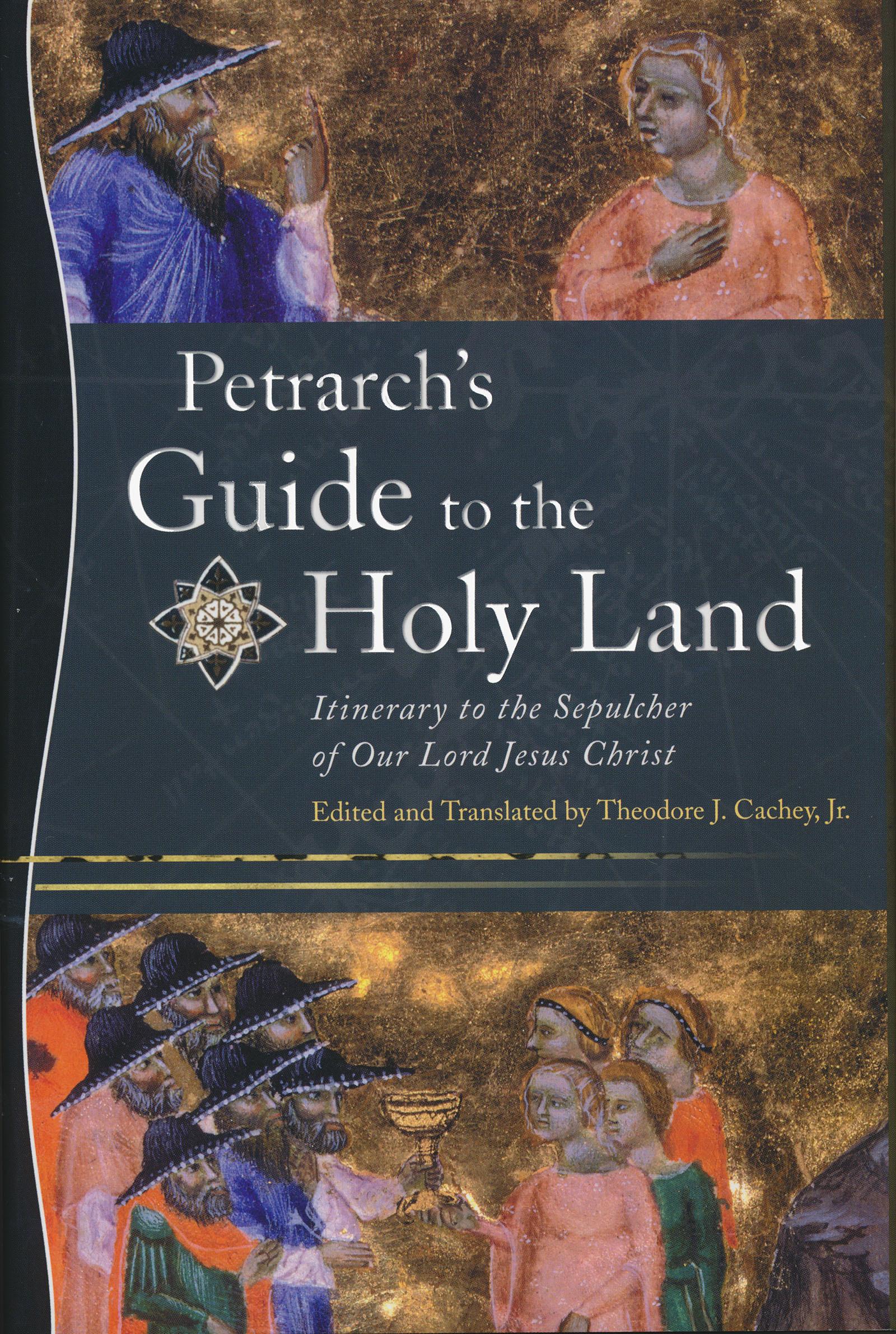
In the early spring of 1358 Francis Petrarch was invited by his friend Giovanni Mandelli, a leading military and political figure of Visconti Milan, to go on a pilgrimage to the Holy Land. Pleased at the invitation, Petrarch nevertheless declined to undertake the journey. Fear of the sea, of shipwreck, and of “slow death and nausea worse than death” held him back. While Petrarch would not make the literal journey he offered Mandelli a pilgrimage guide instead of his companionship: “nevertheless, I shall be with you in spirit, and since you have requested it, I will accompany you with this writing, which will be for you like a brief itinerary.”
Composed over three days between March and April of 1358, the Itinerarium ad sepulchrum domini nostri takes the characteristic Petrarchan form of an epistle to a friend. Delivered to his correspondent in the form of an elegant booklet, the work presents a literary self-portrait that was meant to stand as “the more stable effigy of my soul and intellect” as well as “a description of places.” Although the Holy Land is the ostensible destination of the pilgrimage, more than half of this charming guidebook is devoted to Petrarch’s leisurely and loving descriptions of Italy's physical and cultural landscape. Upon reaching the Holy Land, Petrarch transforms himself into one of the greatest ten-cities-in-four-days Baedekers of all time, as Mandelli and the reader race through sacred landmarks and sites and end up, not at the sepulchrum domini nostri, but at the tomb of Alexander.
Theodore Cachey has prepared the first English-language translation of the Itinerarium. Based on an authoritative 14th-century manuscript in the Biblioteca Statale of Cremona, which is, according to the explicit declaration of the scribe, a copy of Petrarch’s 1358 autograph, the translation is accompanied by the manuscript reproduced in facsimile and by a transcription of the Latin text. Cachey’s extensive introduction and notes discuss Petrarch’s text within the multiple contexts of travel in the Middle Ages and the Renaissance, and contemporary political and cultural issues, including Petrarch’s relation to emergent forms of “cartographic writing” and Renaissance “self-fashioning.” Petrarch’s little book reveals him to be a man of his time, but one whose voice speaks clearly to us across centuries. The Itinerarium is a jewel rediscovered for the modern reader.
Betal enkelt med kort, Klarna, Apple Pay eller Google Pay. Ikke fornøyd? Du har alltid 14 dagers angrerett. Les mer i våre vilkår. Har du spørsmål, send oss en e-post på hello@memmo.org.
Memmo gjør det enklere å studere – uansett hvor du er i verden. Hos oss samler du pensumbøker og smarte studieverktøy på ett og samme sted: sammendrag, quizer, podkaster og flashcards. Og så Ted, din studiekompis som svarer på alt du lurer på. Over 50 000 studenter studerer allerede her – bygget for at du skal lære raskere og stresse mindre.