
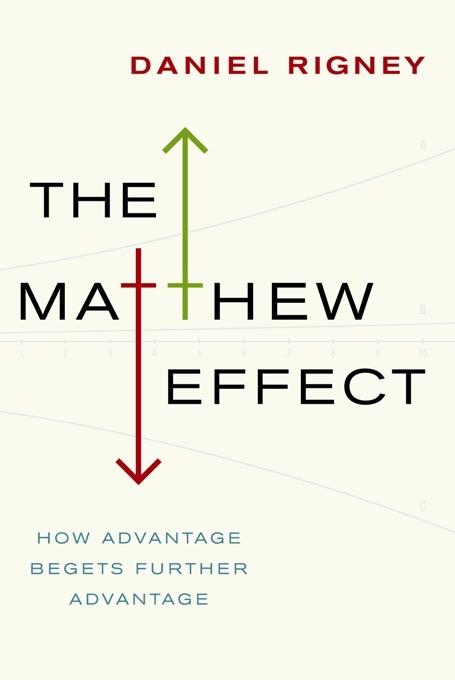
The old saying does often seem to hold true: the rich get richer while the poor get poorer, creating a widening gap between those who have more and those who have less. The sociologist Robert K. Merton called this phenomenon the Matthew effect, named after a passage in the gospel of Matthew. Yet the more closely we examine the sociological effects of this principle, the more complicated the idea becomes. Initial advantage doesn't always lead to further advantage, and disadvantage doesn't necessarily translate into failure. Does this theory need to be revisited?
Merton's arguments have significant implications for our conceptions of equality and justice, and they challenge our beliefs about culture, education, and public policy. His hypothesis has been examined across a variety of social arenas, including science, technology, politics, and schooling, to see if, in fact, advantage begets further advantage. Daniel Rigney is the first to evaluate Merton's theory of cumulative advantage extensively, considering both the conditions that uphold the Matthew effect and the circumstances that cause it to fail. He explores whether growing inequality is beyond human control or disparity is socially constructed and subject to change. Reexamining our core assumptions about society, Rigney causes us to rethink the sources of inequity.
Betal enkelt med kort, Klarna, Apple Pay eller Google Pay. Ikke fornøyd? Du har alltid 14 dagers angrerett. Les mer i våre vilkår. Har du spørsmål, send oss en e-post på hello@memmo.org.
Memmo gjør det enklere å studere – uansett hvor du er i verden. Hos oss samler du pensumbøker og smarte studieverktøy på ett og samme sted: sammendrag, quizer, podkaster og flashcards. Og så Ted, din studiekompis som svarer på alt du lurer på. Over 50 000 studenter studerer allerede her – bygget for at du skal lære raskere og stresse mindre.