
Money and support tend to flow in the direction of economics, science, and other academic departments that demonstrate measurable "progress." The humanities, on the other hand, offer more abstract and uncertain outcomes. A humanist's objects of study are more obscure in certain ways than pathogens and cells. Consequently, it seems as if the humanities never truly progress. Is this a fair assessment?
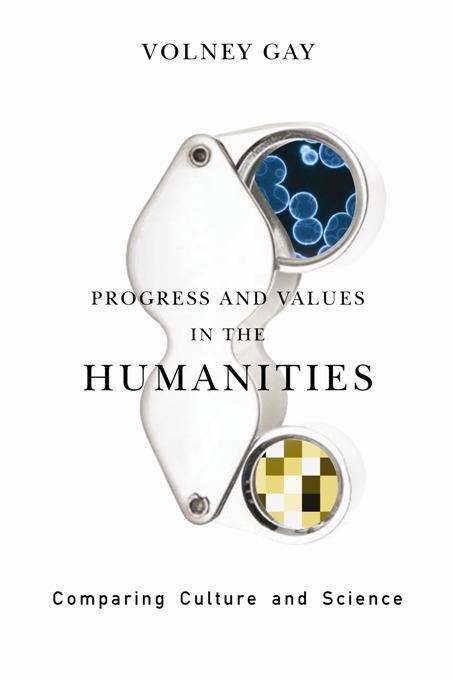
By comparing objects of science, such as the brain, the galaxy, the amoeba, and the quark, with objects of humanistic inquiry, such as the poem, the photograph, the belief, and the philosophical concept, Volney Gay reestablishes a fundamental distinction between science and the humanities. He frees the latter from its pursuit of material-based progress and restores its disciplines to a place of privilege and respect. Using the metaphor of magnification, Gay shows that, while we can investigate natural objects to the limits of imaging capacity, magnifying cultural objects dissolves them into noise. In other words, cultural objects can be studied only within their contexts and through the prism of metaphor and narrative.
Gathering examples from literature, art, film, philosophy, religion, science, and psychoanalysis, Gay builds a new justification for the humanities. By revealing the unseen and making abstract ideas tangible, the arts create meaningful wholes, which itself is a form of progress.
Betal enkelt med kort, Klarna, Apple Pay eller Google Pay. Ikke fornøyd? Du har alltid 14 dagers angrerett. Les mer i våre vilkår. Har du spørsmål, send oss en e-post på hello@memmo.org.
Memmo gjør det enklere å studere – uansett hvor du er i verden. Hos oss samler du pensumbøker og smarte studieverktøy på ett og samme sted: sammendrag, quizer, podkaster og flashcards. Og så Ted, din studiekompis som svarer på alt du lurer på. Over 50 000 studenter studerer allerede her – bygget for at du skal lære raskere og stresse mindre.