
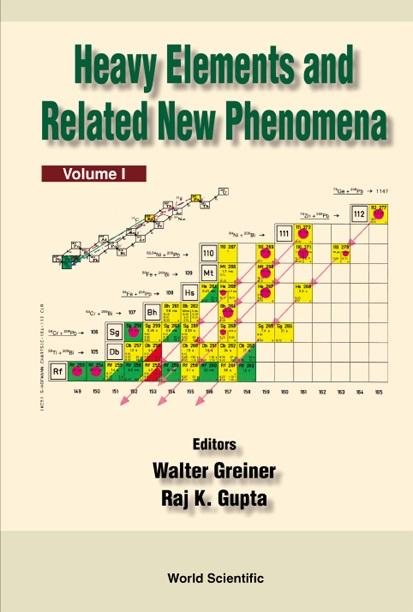
This book reviews recent developments in the field of superheavy elements and the related phenomena of fission, cluster radioactivity, and drip line physics. Both the experimental and theoretical aspects are dealt with in detail. For the production of new elements in the laboratory, the process of cold compound nucleus formation is found to be most favorable both theoretically and experimentally. However, experimentally, hot fusion of nuclei has also been used. Both the physical and chemical methods of synthesizing new elements are discussed. The theoretical approaches considered here are those of the quantum-mechanical fragmentation theory, the self-consistent Hartree-Fock theory, and the relativistic mean field theory. Fission, a process inverse to the fusion of two nuclei, is also observed to be most favourably a cold phenomenon. Other important results are bi-modal fission and high n-multiplicity fission, which leads to the hyperdeformed scission mode. Cluster radioactivity is discussed both as a heavy cluster emission process and as super-asymmetric fission. The theory as well as the present experimental status are reviewed. Physics at drip lines is interesting not only for their structural properties but also for their use in the fusion of two nuclei; both aspects are discussed.
Betaal eenvoudig met kaart, Klarna, Apple Pay of Google Pay. Niet tevreden? Je hebt altijd 14 dagen bedenktijd. Lees meer in onze voorwaarden. Heb je vragen, mail ons dan via hello@memmo.org.
Memmo maakt studeren makkelijker – waar je ook bent ter wereld. Wij brengen je cursusboeken en slimme studietools samen op één plek: samenvattingen, quizzen, podcasts en flashcards. En Ted, je studievriend die antwoord geeft op alles wat je je afvraagt. Meer dan 50.000 studenten studeren hier al – gebouwd om je sneller te laten leren en minder stress te geven.
Misschien vind je dit ook leuk
Koop het boek0