
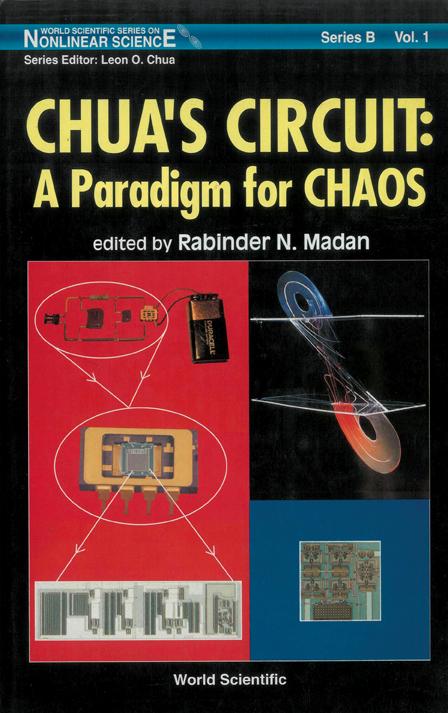
For uninitiated researchers, engineers, and scientists interested in a quick entry into the subject of chaos, this book offers a timely collection of 55 carefully selected papers covering almost every aspect of this subject. Because Chua's circuit is endowed with virtually every bifurcation phenomena reported in the extensive literature on chaos, and because it is the only chaotic system which can be easily built by a novice, simulated in a personal computer, and tractable mathematically, it has become a paradigm for chaos, and a vehicle for illustrating this ubiquitous phenomenon. Its supreme simplicity and robustness has made it the circuit of choice for generating chaotic signals for practical applications.In addition to the 48 illuminating papers drawn from a recent two-part Special Issue (March and June, 1993) of the Journal of Circuits, Systems, and Computers devoted exclusively to Chua's circuit, several highly illustrative tutorials and incisive state-of-the-art reviews on the latest experimental, computational, and analytical investigations on chaos are also included. To enhance its pedagogical value, a diskette containing a user-friendly software and data base on many basic chaotic phenomena is attached to the book, as well as a gallery of stunningly colorful strange attractors.Beginning with an elementary (freshman-level physics) introduction on experimental chaos, the book presents a step-by-step guided tour, with papers of increasing complexity, which covers almost every conceivable aspects of bifurcation and chaos. The second half of the book contains many original materials contributed by world-renowned authorities on chaos, including L P Shil'nikov, A N Sharkovsky, M Misiurewicz, A I Mees, R Lozi, L O Chua and V S Afraimovich.The scope of topics covered is quite comprehensive, including at least one paper on each of the following topics: routes to chaos, 1-D maps, universality, self-similarity, 2-parameter renormalization group analysis, piecewise-linear dynamics, slow-fast dynamics, confinor analysis, symmetry breaking, strange attractors, basins of attraction, geometric invariants, time-series reconstruction, Lyapunov exponents, bispectral analysis, homoclinic bifurcation, stochastic resonance, synchronization, and control of chaos, as well as several novel applications of chaos, including secure communications, visual sensing, neural networks, dry turbulence, nonlinear waves and music.
Betaal eenvoudig met kaart, Klarna, Apple Pay of Google Pay. Niet tevreden? Je hebt altijd 14 dagen bedenktijd. Lees meer in onze voorwaarden. Heb je vragen, mail ons dan via hello@memmo.org.
Memmo maakt studeren makkelijker – waar je ook bent ter wereld. Wij brengen je cursusboeken en slimme studietools samen op één plek: samenvattingen, quizzen, podcasts en flashcards. En Ted, je studievriend die antwoord geeft op alles wat je je afvraagt. Meer dan 50.000 studenten studeren hier al – gebouwd om je sneller te laten leren en minder stress te geven.
Misschien vind je dit ook leuk
Koop het boek0