
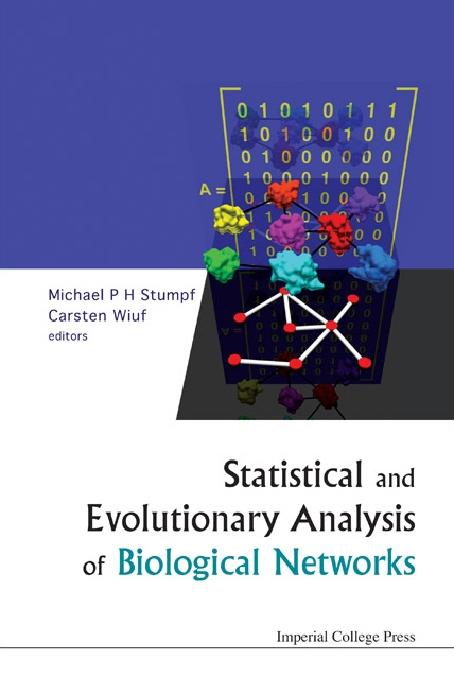
Networks provide a very useful way to describe a wide range of different data types in biology, physics and elsewhere. Apart from providing a convenient tool to visualize highly dependent data, networks allow stringent mathematical and statistical analysis.In recent years, much progress has been achieved to interpret various types of biological network data such as transcriptomic, metabolomic and protein interaction data as well as epidemiological data. Of particular interest is to understand the organization, complexity and dynamics of biological networks and how these are influenced by network evolution and functionality.This book reviews and explores statistical, mathematical and evolutionary theory and tools in the understanding of biological networks. The book is divided into comprehensive and self-contained chapters, each of which focuses on an important biological network type, explains concepts and theory and illustrates how these can be used to obtain insight into biologically relevant processes and questions. There are chapters covering metabolic, transcriptomic, protein interaction and epidemiological networks as well as chapters that deal with theoretical and conceptual material. The authors, who contribute to the book, are active, highly regarded and well-known in the network community.
Betaal eenvoudig met kaart, Klarna, Apple Pay of Google Pay. Niet tevreden? Je hebt altijd 14 dagen bedenktijd. Lees meer in onze voorwaarden. Heb je vragen, mail ons dan via hello@memmo.org.
Memmo maakt studeren makkelijker – waar je ook bent ter wereld. Wij brengen je cursusboeken en slimme studietools samen op één plek: samenvattingen, quizzen, podcasts en flashcards. En Ted, je studievriend die antwoord geeft op alles wat je je afvraagt. Meer dan 50.000 studenten studeren hier al – gebouwd om je sneller te laten leren en minder stress te geven.
Misschien vind je dit ook leuk
Koop het boek0