
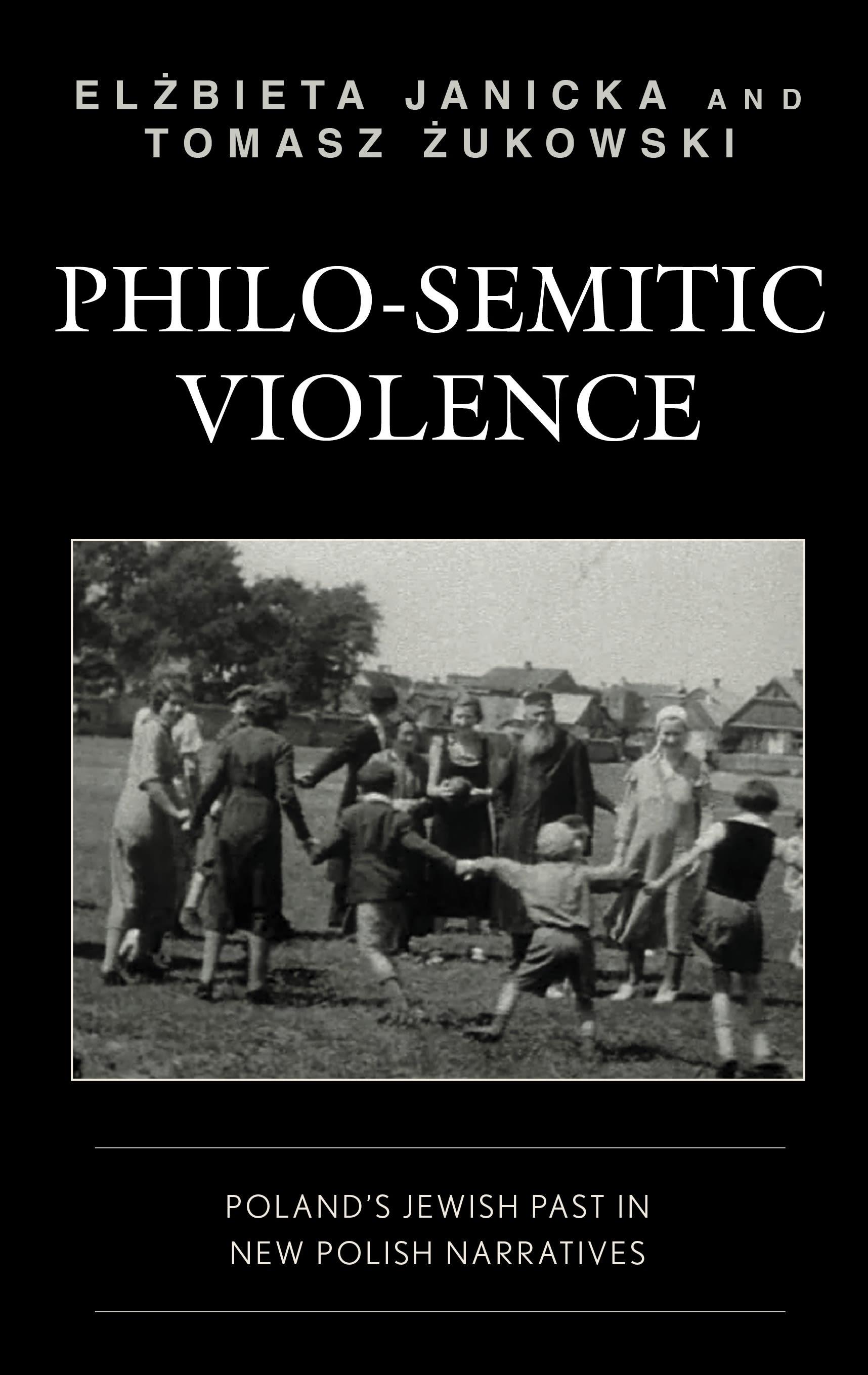
Philo-Semitic Violence: Poland’s Jewish Past in New Polish Narratives addresses the growing popularity of philo-Semitic violence in Poland between the 2000 revelation of Polish participation in the Holocaust and the 2015 authoritarian turn.
Elzbieta Janicka and Tomasz Zukowski examine phenomena termed a “new opening in Polish-Jewish relations,” thought to stem from sociocultural change and the posthumous inclusion of those subjected to anti-Semitic violence. The authors investigate the terms and conditions of this inclusion whose object is an imagined collective Jewish figure.
Different creators and media, same friendly intentions, same warm reception beyond class and political cleavages, regardless of gender and age. The made-to-measure Jewish figure confirms and legitimizes the majority narrative—especially about Polish stances and behaviors during the Holocaust. Enabled by this, philo-Semitic feelings indulge the dominant group in Baudrillard’s retrospective hallucinations. The consequence: aggression toward anyone who dares to interrupt the narcissistic self-staging.
This book exposes the Polish ethnoreligious identity regime that privileges the concern for the collective image over reality. The authors’ inquiry shows how patterns of exclusion and violence are reproduced when anti-Semitism—with its Christian sources and community-building function—is not openly problematized, reassessed, and rejected in light of its consequences and the basic principle of equal rights.
Elzbieta Janicka and Tomasz Zukowski examine phenomena termed a “new opening in Polish-Jewish relations,” thought to stem from sociocultural change and the posthumous inclusion of those subjected to anti-Semitic violence. The authors investigate the terms and conditions of this inclusion whose object is an imagined collective Jewish figure.
Different creators and media, same friendly intentions, same warm reception beyond class and political cleavages, regardless of gender and age. The made-to-measure Jewish figure confirms and legitimizes the majority narrative—especially about Polish stances and behaviors during the Holocaust. Enabled by this, philo-Semitic feelings indulge the dominant group in Baudrillard’s retrospective hallucinations. The consequence: aggression toward anyone who dares to interrupt the narcissistic self-staging.
This book exposes the Polish ethnoreligious identity regime that privileges the concern for the collective image over reality. The authors’ inquiry shows how patterns of exclusion and violence are reproduced when anti-Semitism—with its Christian sources and community-building function—is not openly problematized, reassessed, and rejected in light of its consequences and the basic principle of equal rights.
Betaal eenvoudig met kaart, Klarna, Apple Pay of Google Pay. Niet tevreden? Je hebt altijd 14 dagen bedenktijd. Lees meer in onze voorwaarden. Heb je vragen, mail ons dan via hello@memmo.org.
Memmo maakt studeren makkelijker – waar je ook bent ter wereld. Wij brengen je cursusboeken en slimme studietools samen op één plek: samenvattingen, quizzen, podcasts en flashcards. En Ted, je studievriend die antwoord geeft op alles wat je je afvraagt. Meer dan 50.000 studenten studeren hier al – gebouwd om je sneller te laten leren en minder stress te geven.