
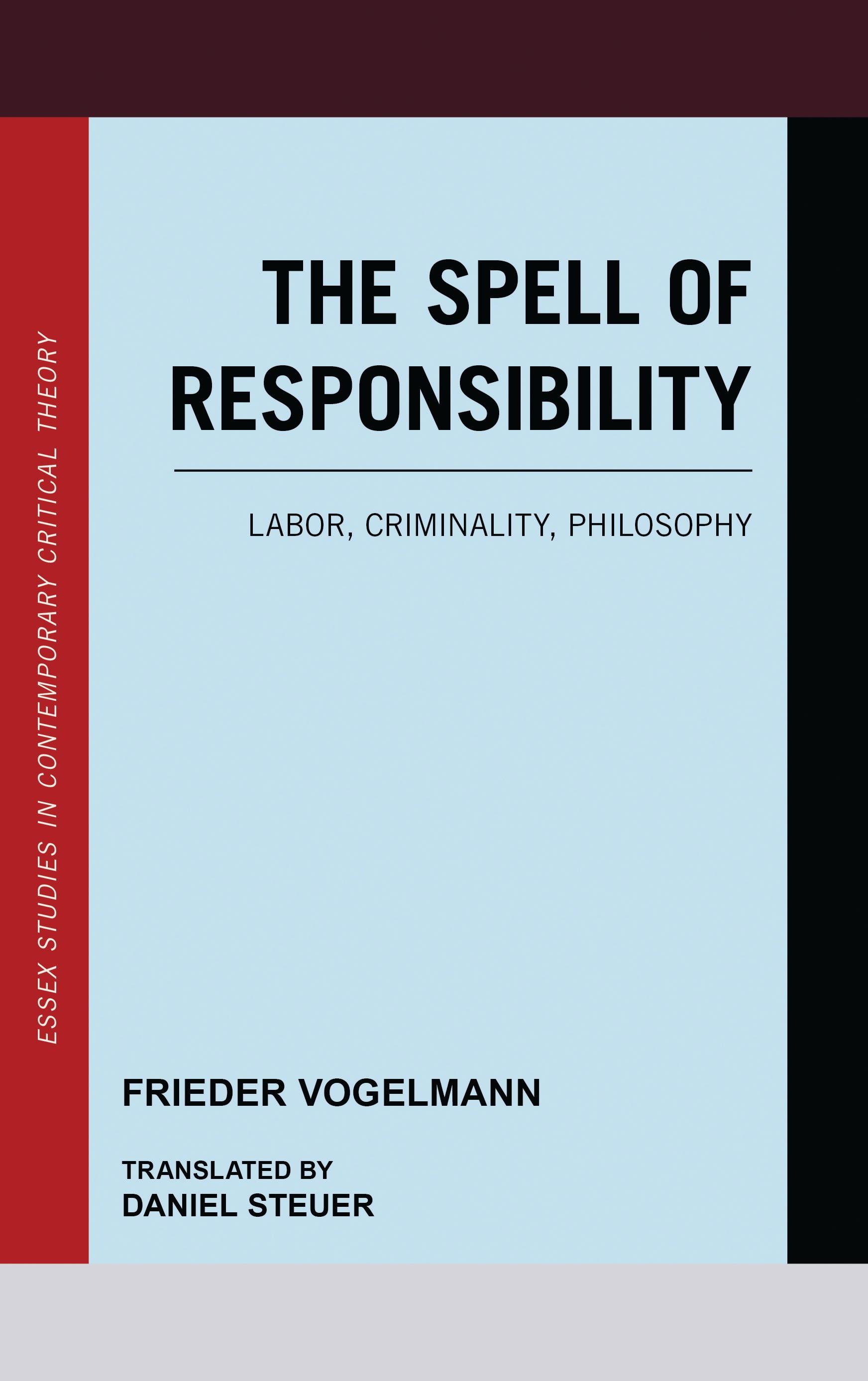
Most people would agree that we should behave and act in a responsible way. Yet only 200 years ago, ‘responsibility’ was only of marginal importance in discussions of law and legal practice, and it had little ethical significance. What is the significance of the fact that ‘responsibility’ now plays such a central role in, for example, work, the welfare state, or the criminal justice system? What happens when individuals are generally expected to think of themselves as ‘responsible’ agents? And what are the consequences of the fact that the philosophical analysis of ‘responsibility’ focuses almost exclusively on conditions of agency that are mostly absent from real life?
In this book, Frieder Vogelmann demonstrates how large parts of philosophy have fallen under responsibility’s spell, and he uses a Foucauldian approach in an attempt to break it. The three axes of power, knowledge, and self are used in a detailed analysis of the practical regimes of labour (including the welfare state), criminality (including policing, punishment practices, and criminal proceedings), and philosophy, and of the two subject positions required by ‘responsibility’ – those of the attributors and bearers of responsibility – within them. The power relations between these positions, which Vogelmann carefully excavates from the grounds of our practices, reveal that the deck is stacked unevenly from the start.
The translation of this work was funded by Geisteswissenschaften International – Translation Funding for Humanities and Social Sciences from Germany, a joint initiative of the Fritz Thyssen Foundation, the German Federal Foreign Office, the collecting society VG WORT and the Börsenverein des Deutschen Buchhandels (German Publisher & Booksellers Association)
In this book, Frieder Vogelmann demonstrates how large parts of philosophy have fallen under responsibility’s spell, and he uses a Foucauldian approach in an attempt to break it. The three axes of power, knowledge, and self are used in a detailed analysis of the practical regimes of labour (including the welfare state), criminality (including policing, punishment practices, and criminal proceedings), and philosophy, and of the two subject positions required by ‘responsibility’ – those of the attributors and bearers of responsibility – within them. The power relations between these positions, which Vogelmann carefully excavates from the grounds of our practices, reveal that the deck is stacked unevenly from the start.
The translation of this work was funded by Geisteswissenschaften International – Translation Funding for Humanities and Social Sciences from Germany, a joint initiative of the Fritz Thyssen Foundation, the German Federal Foreign Office, the collecting society VG WORT and the Börsenverein des Deutschen Buchhandels (German Publisher & Booksellers Association)
Betaal eenvoudig met kaart, Klarna, Apple Pay of Google Pay. Niet tevreden? Je hebt altijd 14 dagen bedenktijd. Lees meer in onze voorwaarden. Heb je vragen, mail ons dan via hello@memmo.org.
Memmo maakt studeren makkelijker – waar je ook bent ter wereld. Wij brengen je cursusboeken en slimme studietools samen op één plek: samenvattingen, quizzen, podcasts en flashcards. En Ted, je studievriend die antwoord geeft op alles wat je je afvraagt. Meer dan 50.000 studenten studeren hier al – gebouwd om je sneller te laten leren en minder stress te geven.