
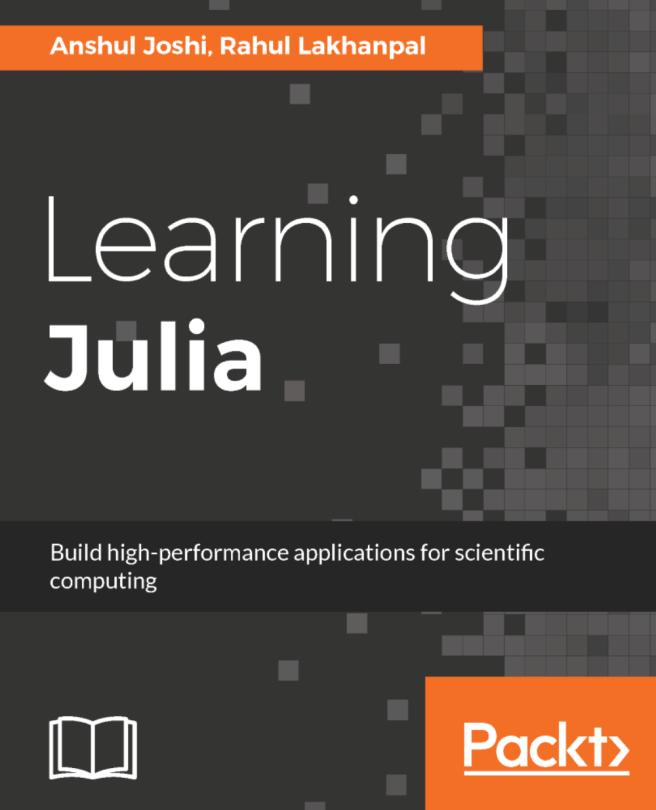
Julia is a highly appropriate language for scientific computing, but it comes with all the required capabilities of a general-purpose language. It allows us to achieve C/Fortran-like performance while maintaining the concise syntax of a scripting language such as Python. It is perfect for building high-performance and concurrent applications. From the basics of its syntax to learning built-in object types, this book covers it all.
This book shows you how to write effective functions, reduce code redundancies, and improve code reuse. It will be helpful for new programmers who are starting out with Julia to explore its wide and ever-growing package ecosystem and also for experienced developers/statisticians/data scientists who want to add Julia to their skill-set.
The book presents the fundamentals of programming in Julia and in-depth informative examples, using a step-by-step approach. You will be taken through concepts and examples such as doing simple mathematical operations, creating loops, metaprogramming, functions, collections, multiple dispatch, and so on.
By the end of the book, you will be able to apply your skills in Julia to create and explore applications of any domain.
Betaal eenvoudig met kaart, Klarna, Apple Pay of Google Pay. Niet tevreden? Je hebt altijd 14 dagen bedenktijd. Lees meer in onze voorwaarden. Heb je vragen, mail ons dan via hello@memmo.org.
Memmo maakt studeren makkelijker – waar je ook bent ter wereld. Wij brengen je cursusboeken en slimme studietools samen op één plek: samenvattingen, quizzen, podcasts en flashcards. En Ted, je studievriend die antwoord geeft op alles wat je je afvraagt. Meer dan 50.000 studenten studeren hier al – gebouwd om je sneller te laten leren en minder stress te geven.